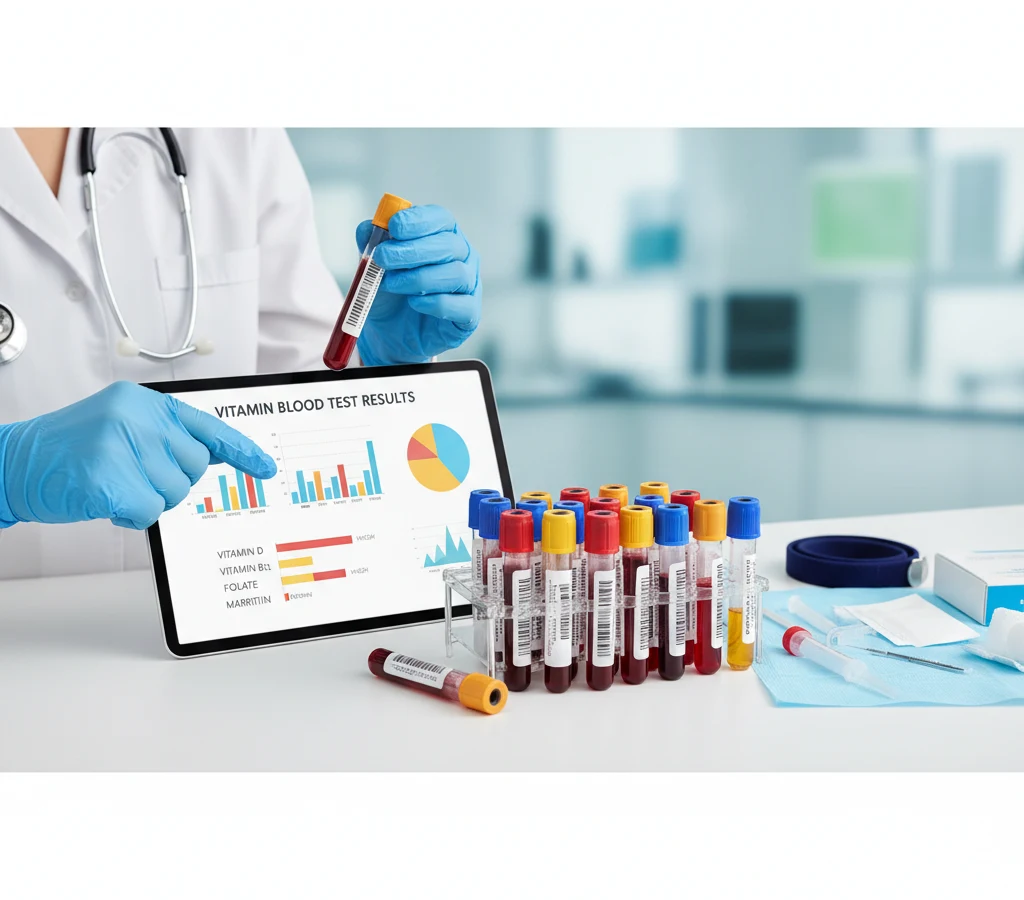

Vitamin Blood Tests: Which Tests to Take Before Supplementing
A vitamin blood test can help investigate a suspected deficiency, but there is no universal panel everyone needs. The most useful approach is to connect your symptoms, diet, medications, and medical history to a specific test—and decide how the result would change your next step.
Vitamin D, vitamin B12, and folate are commonly measured, but testing all three is not automatically necessary. Equally, fatigue or difficulty concentrating does not prove you need vitamins. This guide explains when testing is worthwhile, which measurements matter, and why taking supplements first can sometimes make results harder to interpret.
Relevant GetTested tests are analyzed in CLIA-certified (and, where applicable, CAP-accredited) laboratories and may be HSA/FSA eligible — check with your plan administrator.
How do I know if I have a vitamin deficiency?
Short answer: Symptoms and risk factors can raise suspicion, but they usually cannot confirm a vitamin deficiency. A clinical assessment and appropriately selected blood tests are often needed.
- Evidence: Inadequate vitamin B12 can cause anemia, fatigue, and neurological symptoms; vitamin D deficiency may be associated with bone pain and muscle weakness. Some people have few noticeable symptoms.
- Exceptions: B12-related neurological symptoms can occur without anemia, so a normal blood count does not rule out deficiency.
- Sample type: Usually venous blood for targeted vitamin measurements and supporting tests such as a complete blood count.
- Medical source: NIH Office of Dietary Supplements: Vitamin B12 and Vitamin D.
Possible clues include persistent fatigue, pallor, a sore tongue, unusual weakness, or changes in sensation. However, these overlap with many other health conditions. Poor sleep, thyroid problems, iron deficiency, medication effects, and mental health conditions can produce similar symptoms.
Your risk history is often more informative than a symptom checklist. Relevant factors include a restrictive diet, very limited food intake, gastrointestinal health conditions, previous stomach or bowel surgery, and medications that affect nutrient absorption or metabolism. For example, a vegan diet without a dependable B12 source increases the likelihood of inadequate B12 intake.
Tell a clinician when symptoms began, whether they are worsening, and what you eat over a typical week. Bring a list of medicines, multivitamins, fortified drinks, and individual supplements. A previous normal result may not reflect your current status if your diet or health has changed.
Do not wait for a home test if you develop new or progressive numbness, difficulty walking, marked weakness, or confusion. These need prompt assessment. Chest pain, fainting, severe breathlessness, or sudden neurological symptoms warrant urgent medical attention rather than a vitamin panel.
What vitamin deficiencies should I test for?
Short answer: Test for deficiencies that your symptoms or risk factors make plausible, rather than ordering the widest available panel. B12, folate, and vitamin D are common considerations, but each has different reasons for testing.
- Evidence: NIH guidance identifies specific dietary and absorption-related risks for B12 and folate deficiency. The US Preventive Services Task Force (USPSTF) finds insufficient evidence to determine the benefits and harms of routine vitamin D screening in asymptomatic, community-dwelling, nonpregnant adults.
- Exceptions: Malabsorption, bariatric surgery, severe dietary restriction, or a known deficiency may justify broader or repeated testing under clinical supervision.
- Sample type: Usually venous blood; specialized vitamin tests may require different blood components and handling conditions.
- Medical source: USPSTF: Vitamin D Deficiency in Adults—Screening; NIH: Folate.
Vitamin B12: Consider assessment with unexplained anemia, tingling or numbness, a sore tongue, or problems with balance. Risk factors include limited animal-source or fortified foods, autoimmune gastritis, gastrointestinal surgery, and some intestinal disorders. Long-term metformin or acid-suppressing medication use can also be relevant. Medication use alone does not mean everyone needs the same testing schedule.
Folate, also called vitamin B9: Testing may be useful with certain patterns of anemia, poor intake, heavy alcohol use, or suspected malabsorption. Folate and B12 are often considered together because both can affect red blood cell development. Their results need separate interpretation.
Vitamin D: Testing can be appropriate when there are bone symptoms, suspected osteomalacia, certain calcium abnormalities, malabsorption, or another clinical reason to assess vitamin D status. Limited sun exposure can influence status, but it does not automatically establish a need for screening. Evidence about routine screening should not be confused with evidence about testing someone with a specific clinical concern.
Other vitamins: Vitamins A, E, K, C, and B1 are not usually part of a general screening panel. They may be investigated in targeted situations, such as substantial malabsorption, severe undernutrition, or compatible symptoms. Some suspected deficiencies require urgent clinical decisions rather than waiting for laboratory confirmation.
Iron, magnesium, and zinc are minerals, not vitamins. An iron assessment may be more relevant than a vitamin panel for some people with fatigue, but it should be chosen based on the clinical picture. A larger panel does not necessarily provide a better explanation.
What blood tests check vitamin levels?
Short answer: Different vitamins require different measurements; there is no single blood test that checks all vitamin status. Common tests include 25-hydroxyvitamin D, serum vitamin B12, and serum folate, with additional markers used when results are unclear.
- Evidence: NIH identifies 25-hydroxyvitamin D as the main marker of vitamin D status and methylmalonic acid as a useful supporting marker when B12 results are borderline.
- Exceptions: Kidney function, recent supplementation, immune system responses, and assay differences can affect particular measurements. A supporting marker is not always specific to one deficiency.
- Sample type: Serum or plasma from venous blood is common. Red blood cell folate requires a blood-cell sample; some specialist methods use whole blood.
- Medical source: NIH: Vitamin D, Vitamin B12, and Folate.
25-hydroxyvitamin D, or 25(OH)D: This is the usual vitamin blood test for vitamin D status. The similarly named 1,25-dihydroxyvitamin D test is generally not appropriate for assessing nutritional vitamin D status: its concentration is tightly regulated and may remain normal or rise despite deficiency. It has specialist uses in selected health conditions.
Serum total vitamin B12: This commonly serves as the first measurement. Some laboratories offer active B12, also called holotranscobalamin. A clearly low result supports concern, but a borderline result may require further investigation rather than an immediate yes-or-no conclusion.
Methylmalonic acid, or MMA: MMA can help clarify possible B12 deficiency when the initial result is indeterminate. It can also rise with impaired kidney function, so it should not be interpreted without context.
Serum folate: This reflects circulating folate and can be influenced by recent intake. Red blood cell folate reflects a longer period, but it is not automatically necessary or superior for every clinical question.
Homocysteine: This may rise with inadequate B12 or folate status, but it is not a direct vitamin level. Kidney function and other factors also affect it. An elevated result does not identify a particular deficiency on its own.
Complete blood count: A CBC checks blood cells, not vitamin levels. It can reveal anemia or enlarged red blood cells that prompt further investigation. Routine metabolic panels also do not automatically measure vitamin D, B12, or folate. Check the exact analyte list whenever you compare a vitamin panel test.
Should I test my vitamin levels before taking supplements?
Short answer: Testing first is often useful when investigating symptoms, considering high doses, or assessing a suspected deficiency. It is not necessary before every standard nutritional supplement, and recommended supplementation should not be delayed simply to obtain a baseline result.
- Evidence: Supplements can change measured vitamin concentrations and complicate diagnosis. UK NICE guidance recommends collecting diagnostic samples before starting B12 replacement when feasible, while not delaying care in urgent suspected cases.
- Exceptions: Pregnancy-related folic acid advice and other established dietary recommendations do not depend on a screening vitamin panel. Significant neurological symptoms need prompt clinical assessment.
- Sample type: The sample depends on the vitamin; baseline testing commonly uses venous blood.
- Medical source: NICE: Vitamin B12 Deficiency—Recommendations; NIH: Dietary Supplements—What You Need to Know.
A baseline test is most valuable when it answers a practical question: Is a deficiency present? Is a symptom pattern consistent with it? Is further investigation needed? Would the result change the dose, formulation, or follow-up recommended by a clinician?
If you start supplements first, a later result may reflect supplementation rather than your original status. B12 supplements, for example, can increase measured B12 concentrations and make an underlying problem harder to assess. Record the product name, dose, frequency, and date you started it.
Testing should not become an unnecessary barrier to established nutritional advice. People who could become pregnant are generally advised to take folic acid without first proving a low folate level. People following a vegan diet also need a reliable B12 source; a normal result today does not provide a baseline for your ongoing intake.
More is not necessarily better. Excess vitamin D can cause high blood calcium, excess preformed vitamin A can be harmful, and prolonged excessive vitamin B6 intake can cause nerve problems. Large amounts of folic acid can correct the anemia associated with B12 deficiency without resolving the neurological problem, potentially delaying recognition.
Products marketed as food supplements are not medicines. Vitamin-containing medicines may also be prescribed or recommended for clinical treatment. For food supplements: do not exceed the recommended daily dose. Food supplements should not be used as a substitute for a varied and balanced diet and a healthy lifestyle. Keep out of reach of young children. Clinician-directed replacement for a deficiency is distinct from ordinary supplement use; follow the prescribed regimen rather than combining products independently. Diagnostic tests are not food supplements. These statements have not been evaluated by the Food and Drug Administration. This product is not intended to diagnose, treat, or prevent any disease.
Are at-home vitamin tests reliable, and how should I prepare?
Short answer: An at-home test can be useful when its collection method and laboratory assay are validated for the vitamin and intended use. Reliability also depends on collecting, storing, and returning the sample correctly.
- Evidence: Article 7 of EU Regulation (EU) 2017/746 prohibits misleading device claims. FDA consumer guidance also emphasizes following home-test instructions and interpreting results alongside medical history.
- Exceptions: Finger-prick and venous results are not automatically interchangeable. An insufficient sample, collection error, or unexpected result may require repeat testing. A test intended for one purpose should not be assumed suitable for a healthcare provider's review or monitoring beyond that purpose.
- Sample type: Home collection may use capillary liquid blood or a finger-prick dried blood spot, depending on the service; clinic-based testing commonly uses venous blood.
- Medical and regulatory sources: EU Regulation 2017/746 on in vitro diagnostic medical devices; FDA: Home Use Tests—US consumer guidance.
Distinguish a self-test, which is intended to be used by a lay person, from a home-sampling service, in which you collect a specimen at home and a laboratory performs the analysis. The provider should clearly identify the service, collection method, analyzing laboratory, and supported uses. Review the current instructions and ask how unexpected results are handled.
NIH, USPSTF, and NICE sources in this guide support clinical discussion; they are not EU legal authorities. Food-supplement health-claim rules likewise do not establish a diagnostic test’s regulatory suitability.
There is no universal fasting rule for vitamin testing. Some individual tests do not require fasting, while a combined panel may have different instructions. Follow the collecting laboratory’s requirements rather than assuming that all blood tests need an overnight fast.
Tell the laboratory about medicines and supplements, especially high-dose biotin, which can interfere with certain laboratory assays. Do not stop prescribed medication or clinician-directed supplementation on your own. If a pause is necessary, its timing should come from the laboratory or clinician; there is no single washout period suitable for every vitamin test.
What should I do with my vitamin test results?
Short answer: Interpret results using the laboratory’s units, reference range, your symptoms, and your supplement history. A low or borderline value should lead to a plan that addresses both the result and its possible cause.
- Evidence: NIH notes that vitamin D thresholds and B12 interpretation have limitations; supporting tests can help resolve uncertainty.
- Exceptions: A normal result does not exclude every nutritional problem, and an above-range value does not automatically establish toxicity.
- Sample type: Follow-up may use the same validated blood method or a clinician-selected confirmatory venous sample, provided the method is appropriate for the intended use.
- Medical source: NIH: Vitamin D and Vitamin B12.
For vitamin D, NIH summarizes the National Academies’ view that concentrations below 12 ng/mL indicate increased risk of deficiency, while 20 ng/mL or more is adequate for most people. These are not universal personalized targets, and laboratories and professional groups may use different thresholds. To convert vitamin D from ng/mL to nmol/L, multiply by 2.5.
For B12, an indeterminate result may justify MMA testing or further assessment rather than simply increasing supplements. For folate, recent dietary intake and concurrent B12 status matter. If a deficiency is screened, consider why it occurred: inadequate intake, absorption problems, and medication effects can require different follow-up.
There is no universal retesting interval. Timing depends on the vitamin, initial result, clinical concern, and any changes made. Repeating a broad panel frequently is not automatically useful. The goal is a clear clinical decision—not achieving the highest possible number or purchasing the largest panel.
This article is for general information and is not a substitute for professional medical advice. Talk to a healthcare provider about your results.