
Do you need to fast before a cholesterol test?
Short answer: Usually not for a routine cholesterol check: a nonfasting lipid panel is appropriate for many adults. However, follow your specific test instructions because fasting may be needed to evaluate high triglycerides or answer a particular clinical question.
- Evidence: The 2018 AHA/ACC cholesterol guideline allows either a fasting or nonfasting lipid profile for initial assessment in many adults. A joint European laboratory and cardiovascular consensus also supports routine nonfasting testing.
- Exceptions: A previous markedly elevated triglyceride result, a suspected inherited lipid disorder, or another blood test collected at the same appointment may make fasting necessary.
- Sample type: Blood, usually venous blood for a conventional laboratory lipid panel. At-home collection requirements depend on the specific kit.
- Relevant test: The Cholesterol & Lipid Test provides lipid information; check its current preparation and collection instructions before sampling.
- Medical source: 2018 AHA/ACC Guideline on the Management of Blood Cholesterol.
The old instruction to arrive for every cholesterol test with an empty stomach is no longer universal. For routine cardiovascular risk assessment, eating normally often provides enough information for a healthcare provider to interpret the results.
A standard lipid panel generally includes total cholesterol, HDL cholesterol, triglycerides, and an LDL cholesterol result that may be calculated or measured directly. These measurements do not respond to food in the same way. Triglycerides are the component most affected by a recent meal.
The useful question is therefore not simply whether fasting produces a “better” test. It is whether fasting is needed for the purpose of your test and the laboratory method being used. General guidance supporting nonfasting testing does not override instructions for a particular collection kit.
This article is informational and is not a substitute for professional medical advice. Discuss test preparation and results with a licensed healthcare provider.
How does a meal affect triglycerides?
Short answer: Triglycerides usually rise after eating as your body transports fat from food through the bloodstream. The size and duration of the increase vary with the meal and your underlying metabolism.
- Evidence: A major consensus review found that the maximal average triglyceride increase during the first one to six hours after ordinary meals was about 26 mg/dL. This is a population average, not a limit on an individual’s response.
- Exceptions: Some people have substantially larger increases, particularly after a high-fat meal or when triglycerides are already elevated. Alcohol use and certain metabolic conditions can also affect results.
- Sample type: Blood; a triglyceride measurement can be obtained from a fasting or nonfasting sample when the laboratory accepts that collection condition.
- Medical source: European Atherosclerosis Society and European Federation of Clinical Chemistry and Laboratory Medicine consensus on nonfasting lipid testing.
After a meal, your intestines package dietary fat into particles called chylomicrons. These particles carry triglycerides through the blood so tissues can use or store that energy. Their presence helps explain why a triglyceride result taken after lunch may be higher than one taken before breakfast.
Total cholesterol and LDL cholesterol generally change much less after an ordinary meal. In the same consensus review, their maximal average decreases were about 8 mg/dL, while HDL cholesterol was essentially unaffected. These relatively small average changes help explain why nonfasting panels remain useful for routine screening.
There is no reliable formula for subtracting the effect of your last meal from an individual triglyceride result. Meal composition, timing, alcohol exposure, insulin resistance, and inherited differences all influence the response.
A nonfasting result is not automatically misleading. Most people spend much of the day in a fed state, and nonfasting lipid measurements can provide meaningful cardiovascular risk information. Nevertheless, a particularly high result may require a fasting repeat to clarify the baseline level.
When is a fasting lipid test still recommended?
Short answer: Fasting is often recommended after a markedly elevated nonfasting triglyceride result or when a clinician needs a standardized assessment of a suspected or known lipid disorder. It may also be required for other tests collected alongside the lipid panel.
- Evidence: The 2018 AHA/ACC guideline recommends a fasting repeat when an initial nonfasting triglyceride level is 400 mg/dL or higher. ACC hypertriglyceridemia guidance also identifies specific situations where fasting measurements are needed.
- Exceptions: Not every mildly elevated nonfasting triglyceride result requires an immediate fasting repeat. The decision depends on previous results, the clinical question, and the laboratory’s reporting method.
- Sample type: Fasting blood, usually venous blood in conventional clinical testing.
- Relevant test: The Cholesterol Test – Full Lipid Profile may be relevant when reviewing lipid levels; confirm preparation requirements and suitability with your provider.
- Medical source: 2018 AHA/ACC cholesterol guideline and 2021 ACC Expert Consensus on Hypertriglyceridemia.
A fasting cholesterol test is particularly useful in these situations:
- Nonfasting triglycerides of 400 mg/dL or higher: A fasting repeat helps assess fasting triglycerides and clarify LDL cholesterol interpretation.
- Known or suspected severe hypertriglyceridemia: Fasting results help identify and monitor triglyceride levels associated with increased pancreatitis risk.
- Possible inherited lipid disorders: A standardized fasting profile may support evaluation when personal or family history raises concern.
- Assessment of metabolic syndrome: Fasting triglycerides can be relevant when a clinician evaluates this cluster of metabolic risk factors.
- Monitoring an established triglyceride problem: Comparable collection conditions can make changes over time easier to interpret.
- Combined blood testing: A fasting glucose or another fasting-dependent measurement may determine preparation even if the lipid panel alone would not require it.
The 400 mg/dL repeat-testing threshold is not the same as the threshold for severe hypertriglyceridemia. ACC guidance describes triglycerides of 500 mg/dL or higher as severe, especially at 1,000 mg/dL or higher. These results need clinician assessment; they should not simply be dismissed as the effect of eating.
Does eating affect LDL cholesterol or make the whole lipid panel unreliable?
Short answer: Eating does not usually make the entire panel unreliable. However, elevated triglycerides can make some calculated LDL cholesterol results less dependable.
- Evidence: Routine nonfasting lipid profiles are supported by guidelines, but the traditional Friedewald LDL calculation is generally unsuitable when triglycerides are 400 mg/dL or higher. Laboratories may use other equations or direct measurement.
- Exceptions: A newer calculation method may perform differently from the traditional equation. A direct LDL measurement also has method-specific limitations and is not automatically the best option in every situation.
- Sample type: Blood; the report should identify whether LDL cholesterol was calculated or directly measured when relevant.
- Medical source: Joint consensus on fasting and nonfasting lipid profiles.
Many laboratories calculate LDL cholesterol using other values in the panel rather than measuring it separately. With the traditional equation, triglycerides are part of that calculation. A meal-related triglyceride increase can therefore influence the LDL estimate.
If your report does not include an LDL result, it may be because triglycerides exceeded the laboratory’s calculation limits. That does not necessarily mean the sample was collected incorrectly or that the other measurements are unusable.
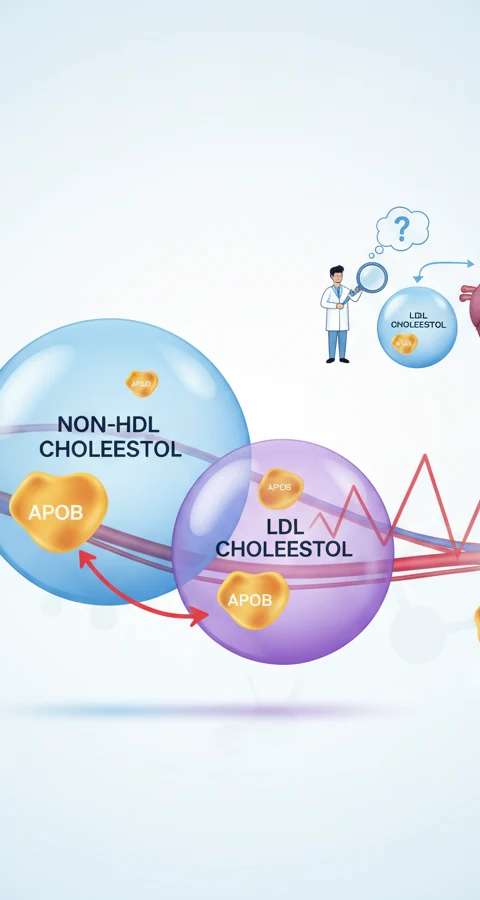
Non-HDL cholesterol is calculated by subtracting HDL cholesterol from total cholesterol. It represents cholesterol carried in particles other than HDL and remains useful in nonfasting samples. A healthcare provider may consider it alongside other findings, particularly when triglycerides are elevated.
Before comparing two LDL results, check whether the fasting status and calculation methods were the same. A difference may reflect biological variation or laboratory methodology as well as a real change in lipid levels.
How should you prepare if fasting is required?
Short answer: Follow the exact fasting interval provided by your healthcare provider or laboratory, commonly 9–12 hours for a fasting lipid panel. Plain water is generally allowed, but food and other drinks are not.
- Evidence: MedlinePlus explains that cholesterol testing may require a 9–12-hour fast and that fasting blood-test preparation generally permits only plain water.
- Exceptions: People with diabetes, pregnancy-related needs, a history of low blood sugar, or other medical considerations should obtain individualized preparation instructions rather than assuming a standard fast is appropriate.
- Sample type: Fasting blood collected according to the laboratory’s instructions.
- Medical source: MedlinePlus: Cholesterol Levels and Fasting for a Blood Test.
For example, if the instruction is a 10-hour fast, the interval runs from your last food or drink other than plain water to the time the sample is collected. Fasting longer than requested does not automatically improve the result.
Coffee, including black coffee, is not part of a standard water-only fast. Neither are tea, juice, soda, energy drinks, or drinks containing milk or cream. MedlinePlus also advises avoiding chewing gum, smoking, and exercise during the fasting period.
Ask the ordering clinician for instructions about medications and supplements; do not make medication changes based on this article. This is particularly important when a medication’s usual schedule involves food or when fasting could affect blood sugar.
Keep preparation representative of your usual routine rather than making an unusual last-minute dietary change to influence the numbers. Ask about any alcohol restrictions in advance, since alcohol can affect triglycerides and laboratory instructions may differ.
What should you do if you accidentally eat before a fasting cholesterol test?
Short answer: Tell the laboratory or healthcare provider what you ate or drank and when. They can decide whether to proceed with a nonfasting sample or reschedule the fasting collection.
- Evidence: Nonfasting lipid testing is acceptable for many routine assessments, while MedlinePlus advises informing the provider when fasting instructions were not followed.
- Exceptions: A collection arranged specifically to investigate high triglycerides, or one that includes other fasting-dependent tests, may need to be rescheduled.
- Sample type: Blood; the fasting status should accurately reflect the conditions at collection.
- Medical source: MedlinePlus: Fasting for a Blood Test.
Eating before the appointment does not mean you have harmed yourself or made all possible blood testing useless. The issue is whether the sample will answer the intended clinical question.
Do not label a sample “fasting” if you had food or a drink other than plain water during the required interval. Accurate documentation helps prevent a post-meal triglyceride increase from being interpreted as a fasting baseline.
If you are collecting a sample at home and are unsure whether preparation requirements were met, contact the testing service before collection when possible. If the sample has already been collected, report the circumstances rather than trying to adjust the result yourself.
Do at-home cholesterol tests have the same fasting rules?
Short answer: The same biological principles apply, but the instructions for the specific at-home test take priority. Do not assume that guidance allowing a nonfasting venous lipid panel applies to every home-collection method.
- Evidence: FDA consumer guidance emphasizes following home-use test instructions, including preparation, sample collection, and interpretation requirements.
- Exceptions: Different products may use different collection devices, sample volumes, laboratory methods, or preparation requirements. Product names alone do not establish these details.
- Sample type: Blood; confirm whether the particular product requires capillary blood collected by finger prick or venous blood. Do not assume a dried blood spot is accepted.
- Relevant test: Review the collection instructions for the Cholesterol & Lipid Test before ordering or sampling.
- Medical source: FDA: Home Use Tests.
Preparation is only one part of obtaining an interpretable result. Collection technique, sufficient sample volume, labeling, storage, and shipping requirements also matter. Follow the kit instructions rather than instructions from a different brand or a previous test.
At-home tests measure or provide information about biomarkers; they do not independently establish a diagnosis. A licensed healthcare provider interprets the findings in the context of your medical history and may recommend confirmatory testing.
Availability can also vary by state and collection pathway. Confirm that the service is available where you live rather than assuming direct-to-consumer testing is offered nationwide.
How should you interpret and compare fasting and nonfasting results?
Short answer: Review the numbers together with fasting status, previous results, and your overall cardiovascular risk. An abnormal value is a reason for clinical interpretation, not a diagnosis by itself.
- Evidence: ACC guidance uses different triglyceride thresholds for fasting and nonfasting samples and emphasizes the importance of repeated measurements and clinical context.
- Exceptions: A markedly elevated result may need assessment even if you recently ate. Conversely, a small difference between tests may reflect ordinary biological or collection variation.
- Sample type: Blood; record whether each sample was fasting and, if relevant, the fasting duration.
- Medical source: 2021 ACC Expert Consensus on Hypertriglyceridemia.
For triglycerides, ACC guidance identifies elevation beginning at 150 mg/dL in fasting samples or 175 mg/dL in nonfasting samples. These thresholds help interpret the collection conditions; they do not mean that a single result determines your overall heart health.
LDL cholesterol, non-HDL cholesterol, blood pressure, diabetes status, smoking history, age, and family history may all affect a clinician’s assessment. A laboratory reference range is not necessarily the same as an individualized clinical goal.
When monitoring trends, using similar collection conditions can reduce avoidable uncertainty. Keep a record of whether you fasted, any unusual meal or alcohol exposure, and whether you were ill around the time of testing.
Bottom line: For routine lipid testing, fasting is often optional. For high triglycerides, certain clinical evaluations, or a kit with explicit fasting requirements, it may be necessary. Confirm the instructions before collection and discuss the results with a licensed healthcare provider.