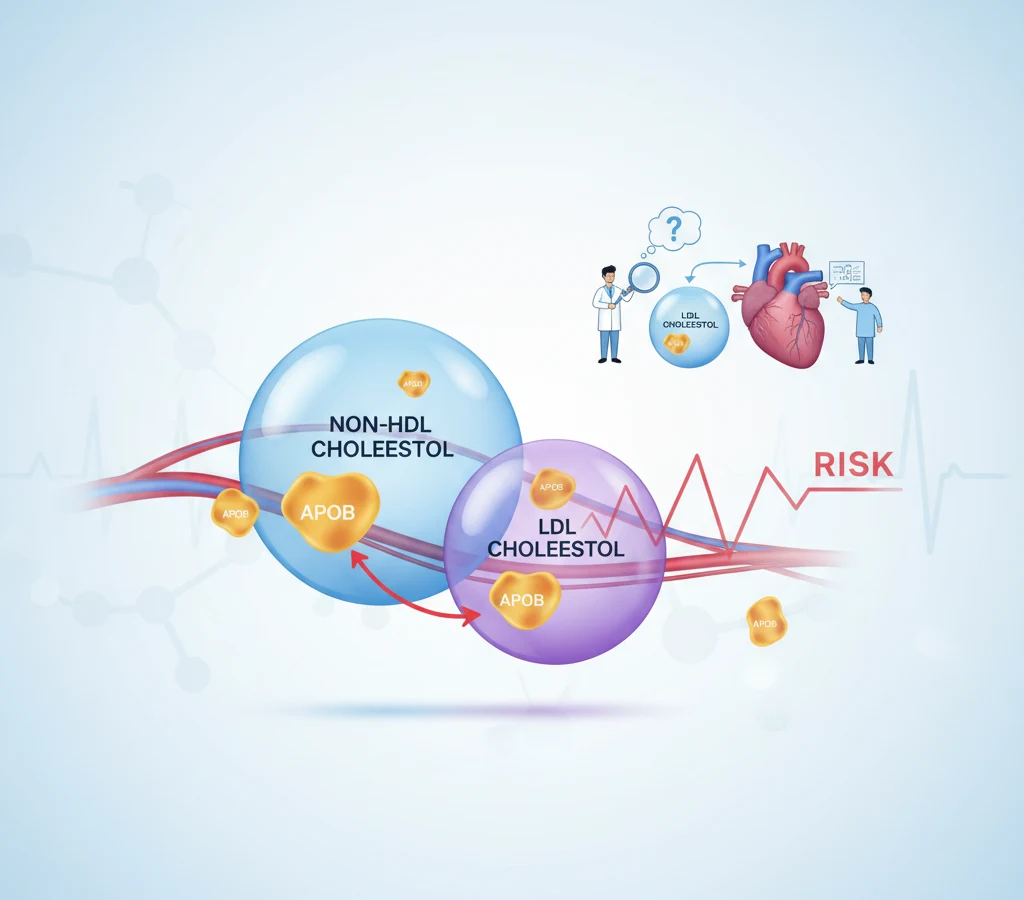

Are non-HDL cholesterol and ApoB better markers of heart risk?
Short answer: Non-HDL cholesterol and ApoB can reveal cholesterol-related risk that LDL cholesterol alone misses, particularly when triglycerides are elevated or the measurements disagree. They complement LDL rather than replace a complete cardiovascular risk assessment.
- Evidence: Research shows that when LDL cholesterol and particle-related measurements disagree, cardiovascular risk can track more closely with non-HDL cholesterol or ApoB. U.S. guidelines recognize elevated ApoB as a risk-enhancing factor in selected adults.
- Exceptions: Not everyone needs additional testing. A standard lipid panel and an assessment of age, blood pressure, smoking, diabetes, and family history may already provide sufficient information for clinical decisions.
- Sample type: Blood; routine clinical testing generally uses venous serum or plasma. At-home collection methods depend on the specific kit.
- Medical source: Mora and colleagues, Circulation: discordance between LDL cholesterol and alternative lipid measurements; 2018 AHA/ACC cholesterol guideline.
The central distinction is cholesterol amount versus particle number. LDL cholesterol measures cholesterol carried inside LDL particles. Non-HDL cholesterol captures cholesterol in a broader group of particles associated with atherosclerosis. ApoB estimates how many of these particles are circulating.
These particles can enter artery walls and contribute to atherosclerosis. However, blood measurements do not show whether an artery is blocked or predict with certainty whether someone will have a heart attack.
This article is informational and is not a substitute for professional medical advice. Discuss test selection and results with a licensed healthcare provider.
What is non-HDL cholesterol?
Short answer: Non-HDL cholesterol is your total cholesterol minus your HDL cholesterol. It represents cholesterol carried by particles other than HDL, including LDL and triglyceride-rich remnant particles.
- Evidence: Non-HDL cholesterol captures a broader range of atherogenic, or plaque-associated, lipoproteins than LDL cholesterol alone. It can be calculated from a standard lipid panel without a separate laboratory assay.
- Exceptions: Non-HDL cholesterol measures cholesterol content, not particle number. It can still disagree with ApoB because particles carry different amounts of cholesterol.
- Sample type: Blood for total cholesterol and HDL cholesterol; non-HDL cholesterol is calculated from those results.
- Relevant test: Cholesterol Test – Full Lipid Profile. Review the current panel details and collection instructions before ordering.
- Medical source: NIH MedlinePlus: Cholesterol Levels—What You Need to Know.
The calculation is straightforward: non-HDL cholesterol = total cholesterol − HDL cholesterol. If total cholesterol is 210 mg/dL and HDL cholesterol is 55 mg/dL, non-HDL cholesterol is 155 mg/dL. Both inputs must use the same units.
Non-HDL cholesterol includes cholesterol in LDL, very-low-density lipoproteins, intermediate-density lipoproteins, remnants, and lipoprotein(a), commonly written as Lp(a). These are different particles with different characteristics, but they all contribute to the cholesterol represented by this calculation.
This broader coverage is especially useful when triglycerides are elevated. In that situation, focusing only on LDL can overlook cholesterol carried in triglyceride-rich particles and their remnants. A high HDL result does not automatically cancel the risk associated with elevated non-HDL cholesterol or ApoB.
What is ApoB, and when is an ApoB test useful?
Short answer: Apolipoprotein B, or ApoB, is a structural protein carried by atherogenic lipoproteins. An ApoB test helps estimate their number and can clarify risk when LDL cholesterol may underestimate the circulating particle burden.
- Evidence: Each major atherogenic particle carries one ApoB molecule, making blood ApoB concentration a practical marker of particle number. The 2018 AHA/ACC guideline identifies triglycerides of at least 200 mg/dL as a relative indication for measuring ApoB.
- Exceptions: ApoB does not measure existing plaque, identify which artery is affected, or capture every cause of cardiovascular disease. Routine testing is not necessary for every person.
- Sample type: Blood, usually venous serum or plasma in routine clinical testing. A specifically ordered ApoB assay is required.
- Medical source: 2018 AHA/ACC guideline on managing blood cholesterol.
Imagine two people whose LDL particles carry the same total amount of cholesterol. One may have fewer cholesterol-rich particles, while the other has more cholesterol-poor particles. Their LDL cholesterol results can look similar, but their ApoB results may differ.
This distinction can matter in people with elevated triglycerides, insulin resistance, type 2 diabetes, or metabolic syndrome. These conditions can be associated with a higher number of relatively cholesterol-poor particles. ApoB may also help when LDL and non-HDL cholesterol tell different stories.
An ApoB test is separate from a standard cholesterol measurement. A panel labeled “heart health” or “cardiometabolic” should not be assumed to include ApoB: check the actual biomarker list. No specific ApoB-containing product is confirmed by the product names supplied for this guide.
Should I test ApoB if my LDL cholesterol is normal?
Short answer: Possibly, especially if your triglycerides are elevated, you have diabetes or metabolic syndrome, or your cardiovascular risk seems higher than your LDL result suggests. A normal LDL result alone is not a reason that everyone needs an ApoB test.
- Evidence: Cohort studies show that LDL cholesterol can underestimate risk when ApoB or non-HDL cholesterol is disproportionately high. U.S. prevention guidelines support using selected risk-enhancing factors to inform uncertain clinical decisions.
- Exceptions: Additional testing may add little when overall risk is low and lipid measurements agree, or when a clinician already has enough information to establish an appropriate care plan.
- Sample type: Blood for a separately ordered ApoB measurement.
- Medical source: Circulation study on lipid-measurement discordance; 2019 ACC/AHA primary prevention guideline.
“Normal” is not the same as “appropriate for your risk.” Laboratory reference ranges describe general categories; they do not necessarily reflect the level a clinician considers appropriate for someone with established cardiovascular disease or other high-risk conditions.
A discussion about ApoB may be worthwhile when:
- Your LDL cholesterol appears reassuring, but triglycerides or non-HDL cholesterol are elevated.
- You have type 2 diabetes, insulin resistance, or features of metabolic syndrome.
- You have a strong family history of premature cardiovascular disease and your standard assessment leaves unanswered questions.
- Your healthcare provider needs to clarify a mismatch between lipid results before making a clinical decision.
Family history can also point toward other assessments, including Lp(a), rather than ApoB alone. The useful question is not simply “Can I measure another marker?” but “Would this result change how my clinician interprets my risk?”
How should non-HDL cholesterol and ApoB results be interpreted?
Short answer: Results should be interpreted alongside your overall cardiovascular risk, not against one universal cutoff. A general reference value, a risk-enhancing threshold, and an individualized clinical goal are different things.
- Evidence: MedlinePlus lists non-HDL cholesterol below 130 mg/dL as a generally healthy adult level. The 2018 AHA/ACC guideline identifies ApoB of at least 130 mg/dL as a risk-enhancing factor.
- Exceptions: People with established cardiovascular disease or other high-risk conditions may need substantially lower clinician-defined levels. ApoB below 130 mg/dL does not automatically mean low risk.
- Sample type: Blood; results are commonly reported in mg/dL in the United States.
- Medical source: NIH MedlinePlus cholesterol reference information; 2018 AHA/ACC cholesterol guideline.
The ApoB threshold above is a specifically defined guideline risk enhancer, not a universal treatment target or a boundary separating safe from unsafe results. Risk changes along a continuum.
Interpretation also depends on age, blood pressure, smoking, diabetes, kidney disease, family history, and previous cardiovascular events. Someone can have relatively favorable lipid measurements and still have important risk from other factors.
Units matter. ApoB may be reported in g/L rather than mg/dL: 1.0 g/L equals 100 mg/dL. That is a conversion between units for the same measurement. There is no reliable fixed formula that converts an LDL cholesterol result into an ApoB result.
What does it mean if LDL, non-HDL cholesterol, and ApoB disagree?
Short answer: Disagreement, called discordance, means cholesterol content and particle number are not telling exactly the same story. A relatively high ApoB can indicate more atherogenic particles than LDL cholesterol alone suggests.
- Evidence: Observational research links discordantly elevated ApoB or non-HDL cholesterol with risk that LDL cholesterol alone may underestimate.
- Exceptions: One unexpected result can reflect biological variation, collection issues, or changes in health. Discordance is not proof of arterial plaque or an imminent cardiovascular event.
- Sample type: Blood; comparing measurements from the same collection can simplify interpretation.
- Medical source: Mora and colleagues: clinical implications of discordant lipid measurements.
Two patterns illustrate the difference:
- Reassuring LDL with higher non-HDL cholesterol: Cholesterol in particles outside the LDL category may be contributing substantially to the total burden.
- Reassuring LDL with higher ApoB: A larger number of relatively cholesterol-poor particles may be present.
These patterns overlap but are not identical. Non-HDL cholesterol is an accessible first step because it uses information already available on a standard lipid panel. ApoB adds a different type of measurement.
Importantly, better risk prediction does not automatically prove that everyone benefits from routine ApoB testing. The strongest practical role is often clarifying uncertainty in a person whose result could meaningfully inform clinical assessment.
Do I need to fast, and can I measure these markers at home?
Short answer: Non-HDL cholesterol and ApoB can generally be assessed without fasting, but follow the instructions for your specific order. At-home collection can provide laboratory information, although the collection method and included biomarkers vary by product.
- Evidence: Expert consensus supports nonfasting lipid testing for routine assessment and reports that ApoB is not meaningfully affected by ordinary meals.
- Exceptions: A clinician may request fasting because triglycerides are markedly elevated or other ordered tests require it. Do not assume that every mail-in blood collection method is suitable for every assay.
- Sample type: Blood. At-home kits may use finger-prick collection; verify whether a specific product uses capillary liquid blood, dried blood spots, or another method.
- Relevant test: Cholesterol & Lipid Test. Confirm the included measurements, preparation requirements, and sample method.
- Medical source: European Atherosclerosis Society and European Federation of Clinical Chemistry consensus on nonfasting lipid testing; FDA: Home Use Tests.
Non-HDL cholesterol does not require a separate ApoB assay: it requires total cholesterol and HDL cholesterol. ApoB must be explicitly included or ordered separately.
The listed GetTested Cholesterol & Lipid Test is analyzed in a CLIA-certified, CAP-accredited laboratory. These credentials apply to the laboratory and do not mean a result is infallible. Sample quality, shipping conditions, and collection technique can affect testing.
At-home tests measure or provide information; they do not diagnose cardiovascular disease. Availability may vary by state, and direct-to-consumer laboratory testing is restricted in some states.
Is ApoB the same as Lp(a), and what should I discuss with my provider?
Short answer: ApoB and Lp(a) are different measurements: ApoB reflects the broader atherogenic particle burden, while Lp(a) measures a particular, largely inherited lipoprotein. Discuss which unanswered risk question each test would address.
- Evidence: U.S. guidelines recognize elevated Lp(a) and elevated ApoB as separate risk-enhancing factors. A family history of premature cardiovascular disease is a relative indication for measuring Lp(a).
- Exceptions: A normal ApoB does not rule out elevated Lp(a). Neither marker replaces a comprehensive cardiovascular assessment.
- Sample type: Blood; Lp(a) requires its own measurement.
- Relevant test: Lp(a) Test – Genetic Heart Risk Marker. This measures Lp(a), not ApoB, and is not a DNA sequencing test.
- Medical source: 2019 ACC/AHA guideline on primary prevention of cardiovascular disease.
Lp(a) particles contain ApoB, but the total ApoB result cannot tell you how much Lp(a) is present. A separate Lp(a) measurement can therefore provide information that an ApoB test does not.
Bring your full lipid panel, previous results, family history, and relevant health history to the discussion. Useful questions include whether your LDL and non-HDL results agree, whether ApoB would clarify uncertainty, and whether an unexpected finding should be repeated.
The takeaway: Non-HDL cholesterol is a readily available way to look beyond LDL. ApoB can add valuable particle-related information, particularly when LDL appears normal despite metabolic risk or elevated triglycerides. Neither result should be interpreted in isolation or used to change medication without a licensed healthcare provider.
What does high ApoB mean, and why is it important for heart health?
Short answer: Beyond a single high result, the duration of exposure matters. Persistently elevated ApoB can indicate an ongoing burden of atherogenic particles, making previous results and the broader health history useful for interpretation.
- Evidence: Atherosclerosis develops over time. The European Atherosclerosis Society describes both the concentration of circulating atherogenic particles and cumulative exposure as important contributors to cardiovascular risk.
- Exceptions: One measurement cannot establish how long ApoB has been elevated or quantify accumulated arterial plaque.
- Sample type: Blood for an ApoB assay; previous blood results can help establish a trend.
- Relevant test: A specifically listed ApoB assay is needed; the supplied product names do not confirm one.
- Medical source: European Atherosclerosis Society consensus on lipoproteins and atherosclerotic cardiovascular disease.
A useful follow-up question is, “Is this a new finding or a longstanding pattern?” A clinician may review earlier lipid measurements, changes in health, and family history before deciding whether repeat testing or further assessment would add useful information. A current result cannot reconstruct lifetime exposure.
What is a normal ApoB level for children and teenagers?
Short answer: Adult ApoB thresholds should not be applied to children. NHLBI pediatric guidance classifies ApoB below 90 mg/dL as acceptable, 90–109 mg/dL as borderline high, and 110 mg/dL or higher as high.
- Evidence: The NHLBI Expert Panel provides age-specific pediatric lipid categories, including these ApoB values.
- Exceptions: These categories are not individualized treatment goals. The same guidance reports that ApoB generally adds no advantage over standard lipid measurements for universal pediatric screening.
- Sample type: Blood; collection and test selection should be arranged with a pediatric healthcare provider.
- Relevant test: No pediatric ApoB product is confirmed in the supplied list.
- Medical source: NHLBI: Integrated Guidelines for Cardiovascular Health and Risk Reduction in Children and Adolescents, Table 9-1.
This age distinction matters when reviewing results for a family rather than one adult. A child's result should be interpreted using pediatric guidance, especially when a parent has a known inherited cholesterol disorder. Do not assume that an adult-oriented home collection kit is suitable for a child.
Is ApoB more important than LDL cholesterol, and is either enough to assess heart disease risk?
Short answer: A marker's usefulness for predicting risk is different from the evidence supporting its role in clinical decisions. LDL cholesterol remains central to U.S. guideline recommendations, while ApoB can address selected uncertainties. Sometimes the unanswered question requires an assessment other than another blood marker.
- Evidence: ACC/AHA guidance allows coronary artery calcium scoring to help resolve certain uncertain prevention decisions after conventional risk assessment and consideration of risk-enhancing factors.
- Exceptions: Calcium scoring is not routine screening for everyone. A score of zero does not exclude noncalcified plaque or automatically outweigh diabetes, smoking, or a strong family history of premature cardiovascular disease.
- Sample type: LDL cholesterol and ApoB use blood; coronary artery calcium scoring uses a CT scan, not a biological sample.
- Relevant test: None of the supplied blood-test products measures coronary artery calcium.
- Medical source: 2019 ACC/AHA primary prevention guideline.
The practical distinction is between asking about circulating lipoproteins and asking whether calcified coronary plaque is present. These assessments provide different information. A clinician can determine whether an unresolved question warrants another laboratory measurement, imaging, or no additional testing.
Should I get ApoB tested if I have a family history of heart disease?
Short answer: The most useful next step is to clarify which relative was affected, what condition they had, and their age when it occurred. Family history alone does not establish that ApoB is the appropriate additional test.
- Evidence: ACC/AHA guidance identifies premature atherosclerotic cardiovascular disease in a first-degree male relative before age 55 or a first-degree female relative before age 65 as a risk-enhancing factor.
- Exceptions: “Heart disease” can also refer to conditions such as valve disease or inherited heart muscle disorders, which require different assessments. A known familial cholesterol disorder also warrants a more specific evaluation than ApoB alone.
- Sample type: Family-history assessment requires no sample; any subsequent laboratory testing depends on the clinical question.
- Relevant test: No single listed product addresses every type of inherited cardiovascular risk.
- Medical source: 2019 ACC/AHA primary prevention guideline: family history as a risk-enhancing factor; 2018 AHA/ACC cholesterol guideline.
Bring details about affected parents, siblings, and children, including ages at heart attack or stroke and any known inherited cholesterol condition. An LDL cholesterol result of at least 190 mg/dL in an adult deserves clinical evaluation regardless of whether ApoB has been measured; ApoB should not become a prerequisite for that discussion.
This information is educational and is not a substitute for professional medical advice. Discuss test selection and results with a licensed healthcare provider.