
HbA1c vs Fasting Glucose vs Fasting Insulin: What Is the Difference?
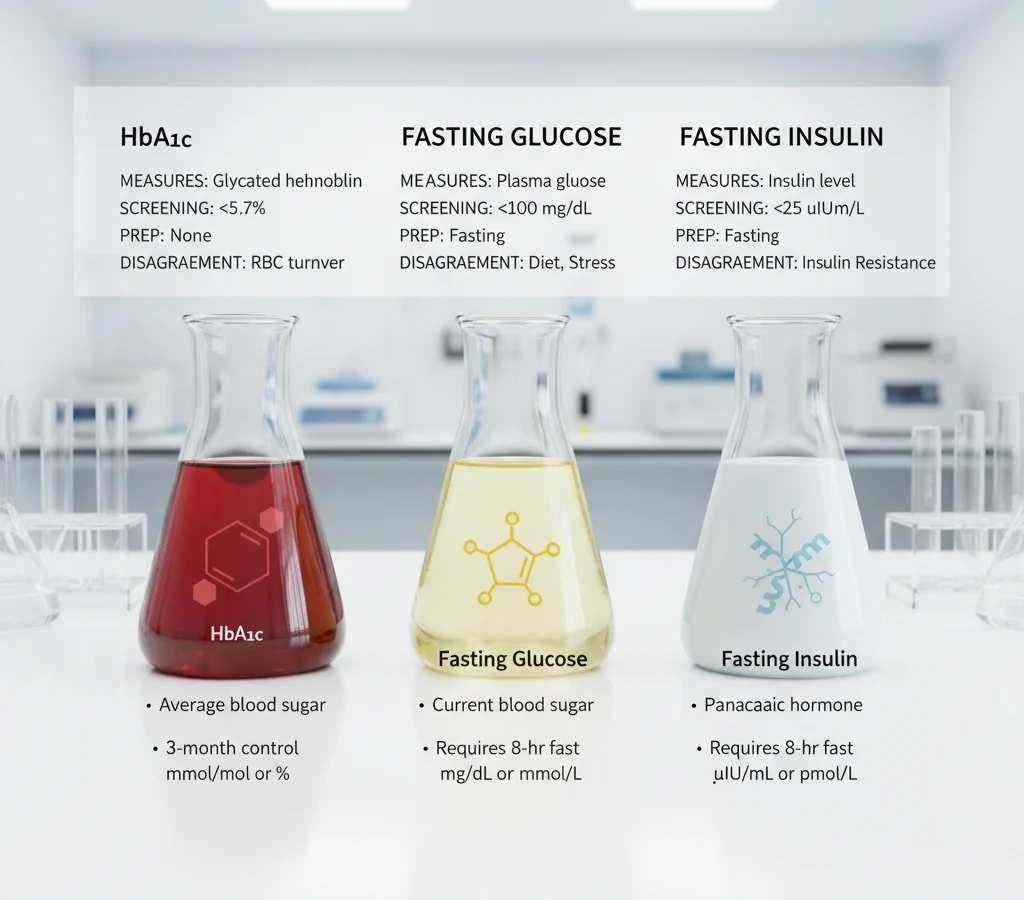
Short answer: HbA1c estimates your average blood glucose over approximately three months, fasting glucose measures it at one moment, and fasting insulin measures the hormone that helps regulate it. These tests answer related—but different—questions.
Relevant GetTested tests are analyzed in CLIA-certified (and, where applicable, CAP-accredited) laboratories and are HSA/FSA eligible — check with your plan administrator for coverage details.
- Evidence: HbA1c and fasting plasma glucose have established thresholds for diabetes. Fasting insulin does not have a universally accepted threshold for insulin resistance or diabetes.
- Exceptions: HbA1c can be unreliable when red blood cell lifespan or hemoglobin is altered, while fasting glucose and insulin are sensitive to preparation and short-term conditions.
- Sample type: HbA1c uses whole blood; standard fasting glucose and insulin measurements usually use venous blood processed for the relevant laboratory method.
- Relevant test: No specific commercial test is recommended here for screening. The linked Blood Sugar Test – Glucose, A1C & Insulin is analyzed in a CLIA-certified, CAP-accredited laboratory; HSA/FSA eligible — check with your plan administrator.
- Medical source: NIDDK: Blood Sugar Tests & Diagnosis.
The simplest comparison is longer-term exposure, current glucose, and insulin response. No single result describes every aspect of glucose regulation, and ordering all three is not automatically necessary.
The sample descriptions below refer to standard clinical laboratory testing, not verified collection methods for individual GetTested products. An at-home collection method should not automatically be treated as interchangeable with the methods used to establish screening thresholds.
Product-link limitation: For every commercial product linked below, EU availability, applicable regulatory conformity, intended purposes, specimen types, and performance documentation remain unverified. These US-market links are retained as product references only, not recommendations for screening. Before publication as EU product recommendations, each requires documentary verification and replacement with a verified EU-market page where available.
What does HbA1c measure?
Short answer: HbA1c measures the percentage of hemoglobin—the oxygen-carrying protein inside red blood cells—with glucose attached. It reflects average glucose exposure over roughly the previous three months, with recent weeks contributing more strongly.
- Evidence: Glucose attaches to hemoglobin during the life of a red blood cell. Standardized HbA1c testing is used to identify increased risk for diabetes, measure these conditions, and monitor established health conditions.
- Exceptions: Pregnancy, some instances of low iron levels, recent blood loss or transfusion, kidney health conditions, and certain hemoglobin variants can affect interpretation.
- Sample type: Whole blood, commonly collected from a vein. Some methods use capillary blood; suitability depends on the specific assay and intended use.
- Relevant test: HbA1c (A1C) Blood Sugar Test analyzed in a CLIA-certified, CAP-accredited laboratory.
- Medical source: NIDDK: The A1C Test & Blood Sugar Levels.
Using clinical criteria for nonpregnant adults, HbA1c results are generally categorized as:
- Below 5.7% (below 39 mmol/mol): below the pre-hyperglycaemia threshold.
- 5.7%–6.4% (39–47 mmol/mol): pre-hyperglycaemia range.
- 6.5% or above (48 mmol/mol or above): high blood sugar range. In the absence of unequivocal hyperglycaemia, results should be discussed with a healthcare provider. Symptoms or suspected hyperglycaemic crisis require prompt clinical assessment rather than reliance on HbA1c alone.
For both the HbA1c categories above and the fasting glucose categories below: These intermediate-risk categories follow clinical criteria. Guidelines used in Europe may define intermediate hyperglycaemia differently; interpretation should follow applicable national guidance and clinical assessment by a doctor.
Some laboratories report HbA1c in mmol/mol rather than percentages. These units describe glycated hemoglobin and should not be confused with the mmol/L units used for blood glucose.
You normally do not need to fast for HbA1c alone. A meal immediately before collection will not meaningfully change it, although fasting may be required when other tests are ordered alongside it.
HbA1c does not reveal daily glucose swings. Two people can have the same HbA1c while experiencing different after-meal peaks or low-glucose episodes. In established health conditions, glucose monitoring may therefore provide information that HbA1c misses.
How is fasting glucose different from HbA1c?
Short answer: Fasting glucose is a snapshot of blood glucose after at least eight hours without caloric intake; HbA1c reflects a longer period. Fasting glucose can change quickly, while HbA1c usually changes more gradually.
- Evidence: Both fasting plasma glucose and HbA1c are accepted screening tests, but they measure different aspects of glucose regulation and may identify different people as having elevated glucose.
- Exceptions: Acute health changes, stress, medications, and incomplete fasting can affect fasting glucose. HbA1c may miss a very recent deterioration in glucose regulation.
- Sample type: Fasting glucose is measured in venous plasma. Home glucose-meter readings are not a substitute for laboratory screening.
- Relevant test: Blood Sugar & HbA1c Test analyzed in a CLIA-certified, CAP-accredited laboratory; HSA/FSA eligible — check with your plan administrator.
- Medical source: NIDDK: Blood Sugar Tests & Diagnosis and WHO: Definition and Diagnosis of Hyperglycaemia and Intermediate Hyperglycaemia.
Using established clinical criteria, fasting plasma glucose in nonpregnant adults is categorized as:
- Below 5.6 mmol/L (below 100 mg/dL): below the impaired fasting glucose threshold.
- 5.6–6.9 mmol/L (100–125 mg/dL): pre-hyperglycaemia range.
- 7.0 mmol/L or above (126 mg/dL or above): high blood sugar range. In the absence of unequivocal hyperglycaemia, results should be reviewed by a healthcare provider.
WHO defines impaired fasting glucose from 6.1 mmol/L (110 mg/dL), rather than the 5.6 mmol/L (100 mg/dL) threshold. HbA1c intermediate-risk categories also vary across guidelines; neither list should be read as a uniform EU standard.
These are categories for a doctor to review, not individualized targets. An unusually low result also needs interpretation; “below 5.6 mmol/L” does not mean every lower value is healthy.
Fasting glucose is influenced partly by how effectively insulin regulates glucose released by the liver overnight. It does not directly measure your response to breakfast, lunch, or dinner. Consequently, someone can have an acceptable fasting result but elevated glucose after meals.
An oral glucose tolerance test assesses the response to a standardized glucose drink and can detect abnormalities not identified by fasting glucose. Clinicians sometimes use it when suspicion remains high or results are inconclusive. Pregnancy requires a separate testing pathway and different interpretation.
What does fasting insulin show?
Short answer: A fasting insulin test measures the insulin circulating in your blood after fasting. Interpreted alongside glucose and clinical information, it can provide results to discuss with a healthcare provider about insulin production and compensation.
- Evidence: Insulin can rise when the body needs more of it to maintain glucose levels. However, insulin assays and proposed cutoffs vary, and routine insulin testing is not recommended for most people being assessed for health risks related to blood sugar.
- Exceptions: A normal insulin result does not exclude insulin resistance. Insulin can be low or inappropriately normal when pancreatic insulin production is impaired.
- Sample type: Usually venous blood, with serum or plasma requirements determined by the laboratory. Follow the specific fasting and collection instructions.
- Relevant test: Fasting Insulin Test analyzed in a CLIA-certified laboratory.
- Medical source: MedlinePlus: Insulin in Blood and clinical laboratory guidelines.
Insulin helps glucose enter certain tissues and reduces glucose production by the liver. When tissues respond less effectively, the pancreas may release more insulin to compensate. During this phase, glucose and HbA1c can remain within their usual ranges.
This explains why fasting insulin sometimes attracts interest as an earlier metabolic marker. The limitation is that there is no universally accepted “optimal” fasting insulin number. Results depend on the assay, population, physiology, medications, and clinical setting. A laboratory reference interval is not the same thing as a validated threshold.
Clinicians and researchers sometimes calculate HOMA-IR from fasting insulin and glucose. The traditional formula is fasting insulin in µU/mL multiplied by fasting glucose in mmol/L, divided by 22.5. When glucose is in mg/dL, the divisor is 405. The measurements need to come from the same fasting assessment.
HOMA-IR estimates insulin resistance indirectly. Different methods and populations produce different thresholds, so an online calculator should not be used to decide on medication.
Insulin testing can also help investigate low blood glucose, but that requires a different clinical approach: insulin may need to be measured during documented low blood sugar alongside other tests. Do not attempt a prolonged fast at home.
Why can HbA1c and glucose results disagree?
Short answer: Results can disagree because the tests cover different time periods, because fasting glucose misses after-meal elevations, or because something affects HbA1c accuracy. A mismatch should prompt clinical review with a healthcare provider.
- Evidence: Red blood cell lifespan, certain hemoglobin variants, low iron levels, and assay-specific interference can change HbA1c independently of glucose. Glucose also varies naturally and with short-term circumstances.
- Exceptions: A small difference around a threshold may reflect ordinary biological and laboratory variation rather than a separate health issue.
- Sample type: Repeat testing commonly uses venous plasma glucose and a standardized whole-blood HbA1c assay. Alternative tests require clinician selection.
- Relevant test: Blood Sugar & HbA1c Test—US-market reference only, subject to the unverified-product limitations above.
- Medical source: NGSP: Factors that Interfere with HbA1c Test Results and NIDDK: The A1C Test & Blood Sugar Levels.
Common explanations include:
- A recent change in glucose: A short-term health change or a medication such as a corticosteroid may raise glucose before HbA1c fully reflects the change. Conversely, recent improvement may lower fasting glucose while HbA1c still reflects earlier weeks.
- After-meal elevations: A normal fasting sample does not rule out higher glucose during the rest of the day.
- Low iron levels: Significant low haemoglobin/iron levels can produce a higher HbA1c than glucose exposure alone would suggest.
- Shortened red blood cell survival: Hemolysis or recovery after substantial blood loss can lower HbA1c despite elevated glucose.
- Recent transfusion: Donated red blood cells can make HbA1c difficult to interpret; the direction of the effect is not reliably predictable.
- Hemoglobin variants: Some interfere with particular assays. The effect depends on both the variant and the laboratory method.
- Kidney health conditions or pregnancy: Changes in red blood cells and related treatments can complicate interpretation.
- Collection or preparation issues: Incomplete fasting can raise glucose, while delayed processing of a glucose sample can lower the measured concentration.
Your clinician may repeat the measurement, review medications, assess iron status, or use glucose-based testing when HbA1c is unsuitable. Fructosamine or glycated albumin sometimes helps with monitoring over a shorter period, but these tests have their own limitations and are not routine replacements for established screening tests for diabetes.
How should you prepare for these tests?
Short answer: HbA1c alone generally needs no fasting; fasting glucose usually requires at least eight hours without food or caloric drinks. For fasting insulin or a combined panel, follow the laboratory’s precise instructions and ask about medication safety. For HSA/FSA eligibility, you should check with your plan administrator.
- Evidence: Standard preparation helps make fasting results interpretable. Eating, drinking calories, exercise, smoking, and some medicines can affect measurements.
- Exceptions: Children, pregnant people, and anyone taking medication that can cause low blood sugar may need individualized fasting instructions.
- Sample type: Blood, collected using the method specified by the laboratory or kit.
- Relevant test: Blood Sugar Test – Glucose, A1C & Insulin—US-market reference only, subject to the unverified-product limitations above.
- Medical source: MedlinePlus: Fasting for a Blood Test.
Plain water is usually allowed. Avoid coffee, tea, gum, smoking, and exercise during the fasting period unless your healthcare team explicitly instructs otherwise. Do not deliberately fast much longer than requested or make unusual dietary changes to obtain a different number.
Do not stop prescribed medication on your own. Ask the ordering clinician how to handle morning doses, particularly insulin or other glucose-lowering medicines. Report an acute health change, recent transfusion, known low iron levels, and relevant supplements or medicines.
For home collection, sample quantity, drying where applicable, storage, and shipping can matter. If collection did not go as instructed, contact the provider rather than assuming the result will remain reliable.
Which test should you choose, and what happens after an abnormal result?
Short answer: For routine blood sugar screening, HbA1c or fasting plasma glucose is usually more appropriate than fasting insulin. An abnormal or inconsistent result needs clinical interpretation by a healthcare provider before a final determination is made.
- Evidence: Accepted screening options include HbA1c, fasting plasma glucose, and an oral glucose tolerance test. Fasting insulin is not part of standard screening criteria for diabetes.
- Exceptions: Symptoms, pregnancy, suspected rapidly developing blood sugar issues, or conditions that distort HbA1c can change the appropriate testing pathway.
- Sample type: Usually laboratory blood testing; the clinician selects the method and any follow-up samples.
- Relevant test: HbA1c (A1C) Blood Sugar Test—US-market reference only, subject to the unverified-product limitations above.
- Medical source: NIDDK: Blood Sugar Tests & Diagnosis.
If two different tests disagree and only one is in the high blood sugar range, clinicians generally repeat the test while considering possible interference. Results close to a threshold may require follow-up rather than an immediate label.
Classic hyperglycaemia symptoms or a hyperglycaemic crisis together with random plasma glucose of at least 11.1 mmol/L (200 mg/dL) can be evaluated by a doctor to establish a health condition. Symptoms accompanying an abnormal HbA1c alone require further professional assessment.
Bring the complete report, including units and reference intervals, to your appointment. Interpretation should also consider symptoms, family history, medications, blood pressure, lipids, and other relevant health information.
Seek prompt medical assessment for marked thirst, frequent urination, or unexplained changes. Vomiting, abdominal pain, deep or rapid breathing, confusion, or severe dehydration warrant urgent care. Do not wait for an at-home test if you feel seriously unwell.
What do eAG and A1C mean together?
Short answer: Estimated average glucose (eAG) is a number calculated from A1C and reported in mg/dL. It is not a second measurement of today's fasting glucose. A1C is a percentage that reflects glucose exposure over roughly three months; eAG expresses that same estimate in the units used for glucose.
Evidence: The NIDDK A1C guide explains that laboratories may report eAG alongside A1C so the long-term average is easier to compare with glucose readings.
Exceptions: eAG can differ from individual meter readings, and A1C may be less reliable when red blood cell turnover or hemoglobin variants affect the assay. A calculated eAG does not diagnose a condition independently.
Sample type: A1C and eAG on the linked panel come from a mailed finger-prick dried blood spot; clinical diagnostic thresholds are based on validated laboratory blood tests and should be interpreted by a clinician.
Relevant test: The GetTested Diabetes Test lists glucose, A1C, insulin and calculated eAG. Medical source: NIDDK, The A1C Test & Diabetes.
What numbers are commonly used for fasting glucose and A1C?
Short answer: For laboratory-based adult screening, NIDDK lists A1C below 5.7% and fasting plasma glucose at or below 99 mg/dL as normal; 5.7–6.4% or 100–125 mg/dL as the prediabetes range; and 6.5% or above or 126 mg/dL or above as diabetes-range results.
Evidence: These are the ranges in NIDDK's diabetes tests and diagnosis guide. A clinician generally confirms an abnormal result with another test unless symptoms and circumstances establish the diagnosis.
Exceptions: Pregnancy, some forms of anemia, recent blood loss and hemoglobin variants can change test choice or interpretation. Finger-prick at-home results should not be treated as equivalent to a diagnostic venous plasma test without clinical validation; a high home result deserves follow-up rather than self-diagnosis.
Sample type: The linked product uses finger-prick dried blood spots; the cited fasting plasma glucose diagnostic cutoffs refer to laboratory plasma. Relevant test: Diabetes Test – Glucose, A1C & Insulin. Medical source: NIDDK, Diabetes Tests & Diagnosis.
Why might fasting glucose be high while A1C is normal?
Short answer: Fasting glucose is a single-moment result; A1C reflects a longer period. A recent change in sleep, illness, medication, stress or collection conditions can affect one result before the other changes. Neither result should be dismissed.
Evidence: The NIDDK A1C guide discusses discordant results. Our guide to results that disagree covers red blood cells and assay limitations in more detail.
Exceptions: A1C can be misleading in some blood disorders; a single abnormal glucose result cannot identify its cause. A clinician may use repeat fasting plasma glucose, A1C or another appropriate test.
Sample type: Compare the report's specimen type, reference interval and preparation before comparing results. Relevant test: GetTested Diabetes Test. Medical source: NIDDK, Diabetes Tests & Diagnosis.
How long should I fast, and how often should I be retested?
Short answer: A1C alone does not require fasting; fasting glucose generally requires at least eight hours. This linked US panel also measures insulin and its listed preparation calls for a morning finger-prick sample after a 10–12 hour overnight fast. Follow the instructions supplied with your particular kit; do not apply those instructions to every test.
Evidence: NIDDK describes clinical fasting glucose testing and recommends repeat or confirmatory testing when results suggest prediabetes or diabetes. Screening frequency varies by age, risk and previous results.
Exceptions: Pregnancy, symptoms, prior abnormal results, medication use and family history may change timing or the test selected. Do not fast if your clinician has advised against it. A home sample is not a substitute for a clinical diagnosis or an emergency assessment.
Sample type: This US product lists a mailed finger-prick dried blood spot; clinical fasting plasma glucose thresholds are for laboratory plasma. Relevant test: GetTested Diabetes Test. Medical source: NIDDK, Diabetes Tests & Diagnosis.
This article is for general information and is not a substitute for professional medical advice. Talk to a healthcare provider about your results. These statements have not been evaluated by the Food and Drug Administration. This product is not intended to diagnose, treat, or prevent any disease.