
Dried Blood Spot vs Venous Blood Testing: Which Sample Is Right for You?
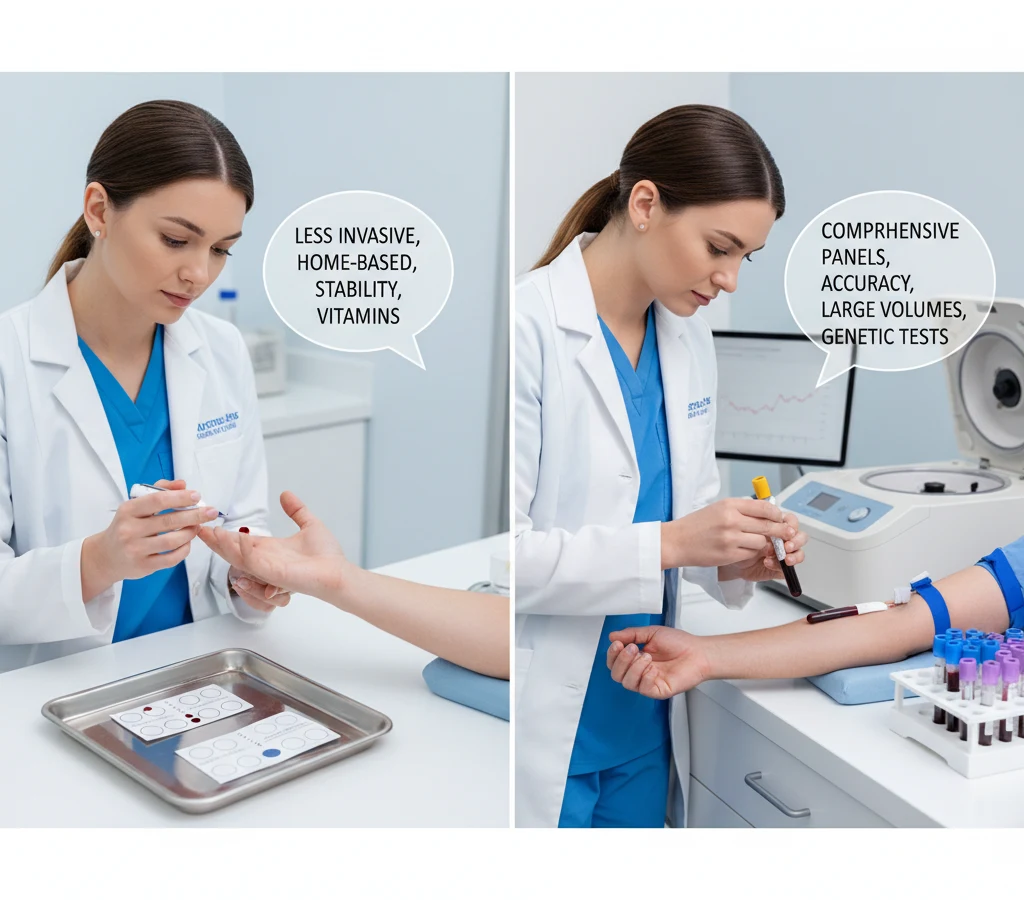
Short answer: A dried blood spot test can be useful to screen selected biomarkers when the laboratory has validated its collection and analysis methods. A venous blood test supports a much wider range of measurements and is usually needed for complex investigations, urgent testing, or to provide results to discuss with a healthcare provider.
- Evidence: Dried blood spots are established in newborn screening, while routine clinical laboratory testing uses several specimen types, including venous whole blood, serum, and plasma. Suitability depends on the specific measurement—not simply whether blood comes from a finger or a vein.
- Exceptions: Some dried blood spot methods perform well for their intended purpose; conversely, a poorly collected or improperly transported venous sample can produce unreliable results.
- Sample type: Finger-prick capillary blood dried on a collection card versus venous blood collected into a tube.
- Medical source: HRSA: Newborn Screening Process; WHO Guidelines on Drawing Blood.
The practical difference is not simply “home testing versus laboratory testing.” Both sample types may be analysed in a laboratory. The important differences are how blood is collected, what happens before analysis, and whether the method can answer the clinical question reliably. Relevant GetTested tests are analyzed in CLIA-certified, CAP-accredited laboratories and are HSA/FSA eligible — check with your plan administrator.
Dried blood spot collection uses a small amount of blood and may avoid travel to a collection centre. However, collecting enough suitable blood can be difficult, and mailing adds time. Venous collection requires a trained professional but provides more material for multiple measurements, repeat analysis, and specialised processing.
Neither option is automatically more accurate in every situation. A good comparison asks whether the particular test has acceptable precision, agreement with an established method, and appropriate reference intervals for that sample type.
What is a dried blood spot test?
Short answer: A dried blood spot test measures substances in small drops of whole blood that have dried on specially designed filter paper. For adults, the blood is commonly collected through a finger prick and then sent to a laboratory to check markers.
- Evidence: Public health newborn screening programmes have used dried blood spots for decades, demonstrating that this collection format can support reliable testing for selected markers.
- Exceptions: Success in newborn screening does not establish that every adult wellness or hormone test is suitable for dried blood spots. Each measurement requires its own validation.
- Sample type: Dried capillary whole blood; newborn screening typically uses a heel-prick sample.
- Medical source: HRSA: Newborn Screening Process.
After collection, the card must dry according to the kit’s instructions before packaging. The laboratory then extracts the substance being measured from the dried blood. Some methods analyse a punched-out section of a spot; others use a different extraction or volume-control approach.
A dried blood spot contains both blood cells and the liquid components of blood. This makes it different from serum or plasma, which are separated from cells during laboratory processing. A concentration measured in dried whole blood cannot automatically be interpreted using a serum reference range.
Also, not every finger-prick test is a dried blood spot test. Finger-prick blood may instead be collected into a small liquid-blood tube or placed directly onto a glucose meter strip. These approaches have different handling requirements and performance characteristics.
Which biomarkers work well on dried blood spots, and which usually need venous blood?
Short answer: Published studies support HbA1c measurement using particular dried blood spot protocols, but they do not establish that every collection card or laboratory assay is clinically suitable. Routine blood measurements, clotting studies, electrolytes, and many chemistry or hormone investigations generally require a suitable liquid-blood specimen.
- Evidence: A systematic review compared dried blood spot and venous HbA1c measurements using multiple analytical protocols, including chromatography and immunoassay approaches. Results were promising overall, but differences between methods, handling conditions, and study designs limit generalisation to an unstudied test.
- Exceptions: Analytical measurability or correlation with venous results does not establish accuracy at clinical thresholds, or an authorised intended purpose. The examples discussed here describe published methods and clinical settings, not the collection methods of GetTested products.
- Sample type: Dried whole blood collected, stored, extracted, and analysed under a specifically evaluated protocol; venous whole blood, serum, or plasma for many routine investigations.
- Medical source: Affan and colleagues: Systematic review of dried blood spot versus venous HbA1c and lipid measurements; NIDDK: The A1C Test & diabetes; MedlinePlus: Complete Blood Count; NIH: Vitamin D Fact Sheet.
HbA1c: This measures the proportion of haemoglobin with glucose attached and reflects average blood glucose over roughly three months. Because haemoglobin is inside red blood cells, whole blood is the appropriate starting material. The reviewed dried blood spot studies evaluated extraction from filter paper followed by laboratory analysis; their findings cannot be transferred automatically to another card, extraction procedure, analyser, or postal collection pathway. Storage conditions and method-specific bias matter, particularly near thresholds. Low haemoglobin levels, recent blood loss or transfusion, and some haemoglobin variants can also affect interpretation.
Vitamin D: Serum 25-hydroxyvitamin D is the established marker of vitamin D status. Relevant test: Vitamin D (25-OH) Test, analyzed in a CLIA-certified, CAP-accredited laboratory. Any proposed alternative needs analyte-specific evidence covering extraction, calibration, sample-matrix effects, stability, and agreement with an appropriate serum method—not simply evidence that vitamin D can be detected.
Inflammatory markers and lipids: Do not infer suitability for C-reactive protein or a complete lipid panel from evidence about HbA1c. Each measurement needs its own validation, including analytical sensitivity, stability, and agreement with the established serum or plasma method. A correlation across a broad concentration range does not by itself establish interchangeability near a clinical decision threshold.
Thyroid and reproductive hormones: Newborn screening experience does not validate an adult thyroid panel containing free T4, free T3, or thyroid antibodies. Likewise, an assay’s ability to detect testosterone or oestradiol does not establish reliable measurement at very low concentrations or of free hormone levels. Venous serum or plasma is generally the established specimen for hormone investigations. A doctor diagnoses hormonal conditions.
Glucose and insulin: A dried blood spot HbA1c result is not a substitute for a fasting plasma glucose measurement. Glucose changes after collection unless the sample is handled appropriately, while insulin results depend on fasting status, assay characteristics, and specimen handling. Do not combine measurements from different times or unsupported specimen methods to calculate insulin resistance markers.
Complete blood count: A standard CBC needs intact cells in an appropriate anticoagulated liquid-blood sample. A conventional dried spot cannot provide the routine cell counts and cell characteristics obtained from a CBC analyser.
Electrolytes and kidney chemistry: Potassium is especially problematic because blood cells contain substantial potassium, and cell damage can distort results. Relevant test: Kidney Function Test, analyzed in a CLIA-certified, CAP-accredited laboratory. Specialised microsampling methods should not be confused with an ordinary dried blood spot card.
Clotting tests: Routine laboratory PT/INR and aPTT testing require carefully collected specimens and controlled processing. Some point-of-care INR devices use fresh capillary blood, but that is not dried blood spot testing.
Is dried blood spot testing as accurate as a venous blood test?
Short answer: It can be sufficiently accurate to screen a particular validated measurement, but there is no single accuracy rating for all dried blood spot tests. Accuracy depends on the biomarker, collection quality, shipping conditions, and laboratory method.
- Evidence: WHO guidance emphasises that collection and handling influence specimen quality. Published dried blood spot comparisons also show why performance must be assessed for the specific analyte and protocol.
- Exceptions: Strong agreement across a broad range of results may still hide clinically important differences near a decision threshold or at very low concentrations.
- Sample type: Dried capillary whole blood compared with the specific venous specimen used by the reference method.
- Medical source: WHO Guidelines on Drawing Blood; FDA: Home Use Tests; Affan and colleagues: Dried blood spot comparison review.
Haematocrit matters. Haematocrit is the proportion of blood occupied by red blood cells. It can influence how blood spreads across filter paper and how much material is present in a punched section. The effect varies by analyte and collection system.
Sample volume matters. Small, incomplete, layered, or uneven spots can compromise analysis. Some collection devices control volume more effectively than traditional cards, but they still require validation.
Transport matters. Drying can improve the stability of some substances, but it does not preserve every biomarker equally. Heat, humidity, and excessive shipping time may affect results. Venous specimens have their own transport and processing requirements.
Useful questions for a provider include: Was this exact biomarker validated on this collection device? What are the sample rejection criteria? What shipping conditions were tested? Are the reference intervals appropriate for the reported measurement?
How should you collect and prepare a dried blood spot sample?
Short answer: Follow the kit’s instructions exactly, including any fasting, timing, drying, and shipping requirements. Do not assume that instructions from a different finger-prick kit apply.
- Evidence: Blood-collection guidance identifies contamination, excessive squeezing, inadequate sample volume, and handling errors as potential sources of unreliable results.
- Exceptions: People with bleeding disorders, poor circulation, or difficulty obtaining a sample may need professional collection. Follow clinician advice if you take medicines that affect bleeding.
- Sample type: Finger-prick blood applied to the specified collection card or device.
- Medical source: WHO Guidelines on Drawing Blood; FDA: Home Use Tests.
Check preparation requirements before opening the kit. HbA1c alone generally does not require fasting, but another biomarker in the same panel may. Hormone measurements may require a particular collection time or menstrual-cycle day.
Wash and dry your hands and follow the supplied instructions for cleaning the puncture site. If an alcohol wipe is used, allow the skin to dry. Instructions about whether to wipe away the first drop can vary; use the directions for your specific device.
Avoid forcefully squeezing the finger. Apply blood as directed without touching the collection area, smearing the sample, or adding repeated layers unless explicitly instructed. Allow the card to dry for the specified period, away from contamination and direct heat.
Do not package a damp card or use a hair dryer to accelerate drying. Use the supplied packaging and desiccant if provided, then return the sample within the stated timeframe. An inadequate sample should be recollected rather than interpreted with false confidence.
Can you compare dried blood spot results with previous venous results?
Short answer: Sometimes, but do not assume results are directly interchangeable. Compare the units, laboratory method, specimen type, and reference interval before interpreting a change.
- Evidence: Laboratory results depend on the analytical method and reference range; a value outside a range is not automatically a diagnosis. Standardisation is especially important when measurements guide clinical decisions.
- Exceptions: A laboratory may validate a dried blood spot result against a venous method and report comparable values. Even then, small differences may reflect measurement variation rather than a biological change.
- Sample type: Dried whole blood versus venous whole blood, serum, or plasma, as specified on each report.
- Medical source: MedlinePlus: How to Understand Your Lab Results; NIDDK: The A1C Test & diabetes.
For tracking a trend, using the same laboratory, sample type, and collection conditions can reduce avoidable variation. Record relevant factors such as fasting status, collection time, recent health condition, and menstrual-cycle timing when applicable.
An unexpected result deserves review rather than an immediate conclusion. A clinician may recommend repeating the measurement using an established venous method, especially when the result is borderline, conflicts with symptoms, or would change medical management. A doctor diagnoses medical conditions.
In the absence of unequivocal hyperglycaemia, diagnosing diabetes requires confirmation with a second abnormal result by a provider, following an appropriate clinical diagnostic pathway. A home-collected HbA1c result should not be used alone to identify diabetes.
When should you choose venous blood testing instead?
Short answer: Choose venous testing when the requested biomarker needs serum, plasma, or intact blood cells, or when your clinician needs a standard investigation. Do not wait for a mailed home sample if you have urgent symptoms.
- Evidence: Routine investigations such as a comprehensive metabolic panel and complete blood count use specified liquid-blood specimens. These provide information that a generic dried blood spot card cannot replace.
- Exceptions: Some tests can use professionally collected capillary micro-samples or validated point-of-care methods; these are distinct from mailed dried blood spots.
- Sample type: Venous serum, plasma, or anticoagulated whole blood, depending on the investigation.
- Medical source: MedlinePlus: Comprehensive Metabolic Panel; MedlinePlus: Complete Blood Count.
Venous testing is also often more practical when several panels are needed, when the laboratory may need additional sample for repeat measurements, or when professional collection is preferable to repeated unsuccessful finger pricks.
Chest pain, severe breathlessness, fainting, confusion, or significant bleeding require prompt medical assessment—not home testing. A normal home-test result cannot rule out every important cause of symptoms.
Bottom line: Select the test around the clinical question first and convenience second. A validated dried blood spot method can be a useful collection option to screen selected biomarkers; a venous blood test remains the broader and more established option for many investigations.
This article is for general information and is not a substitute for professional medical advice. Talk to a healthcare provider about your results. These statements have not been evaluated by the Food and Drug Administration. This product is not intended to diagnose, treat, or prevent any disease.