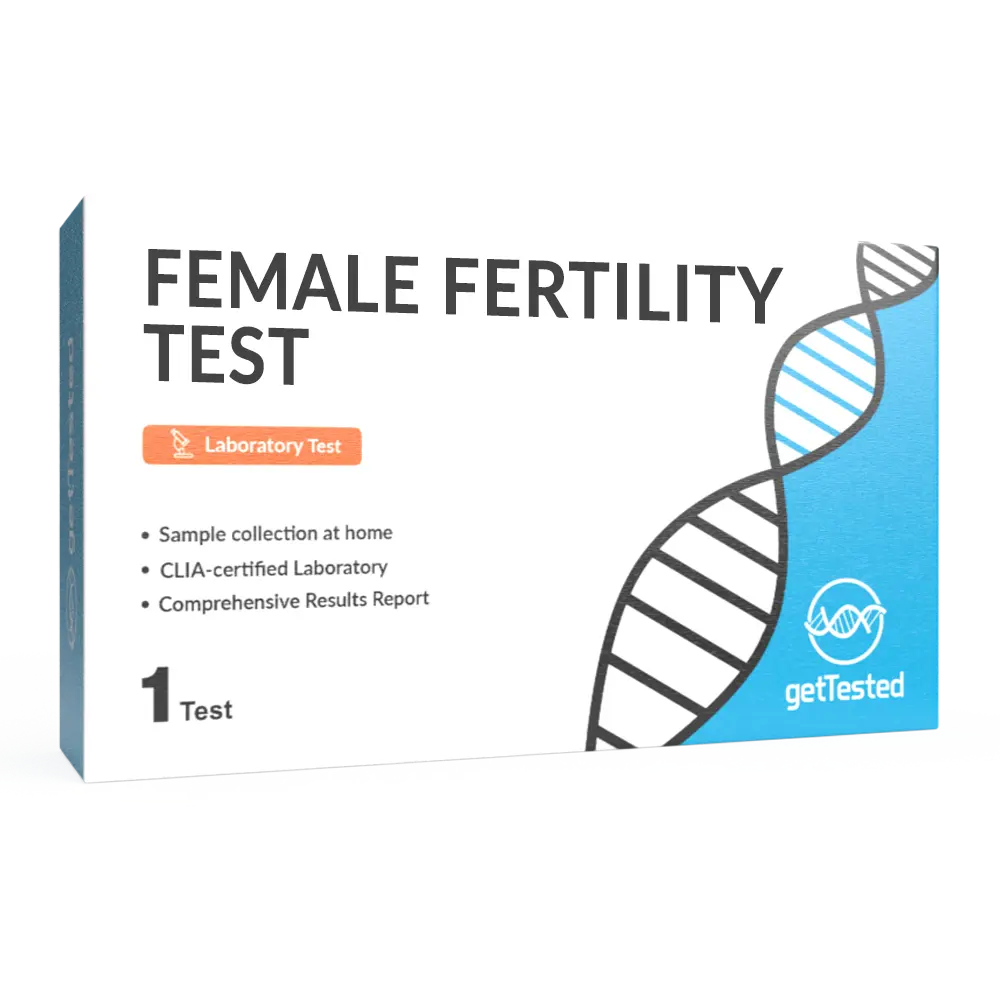
Female Fertility Test – Fertility Hormones

Measure key fertility hormones like AMH, FSH, LH, Estradiol, TSH, and Prolactin with our at-home female fertility test kit. Get insights into ovarian reserve and hormonal balance for proactive reproductive health planning.
Product details: USD 149 — InStock — SKU GT_022 — GetTested
About this test
Check Key Fertility Hormones at Home
Understanding your fertility begins with understanding your hormones. Our At-Home Female Fertility Test provides insights into several important reproductive hormones, helping you better understand ovarian reserve, ovulation potential, and overall hormonal balance.
This test is designed for convenience and accuracy, allowing you to monitor key fertility-related hormones from home. It can be useful whether you are planning a future pregnancy, trying to conceive, or simply interested in learning more about your reproductive health.
What This Test Measures
This panel measures six important hormones involved in reproductive health and menstrual cycle regulation:
Anti-Müllerian Hormone (AMH): Often used as an indicator of ovarian reserve, reflecting the number of eggs remaining in the ovaries.
Follicle-Stimulating Hormone (FSH): Plays an important role in stimulating the growth of ovarian follicles prior to ovulation.
Luteinizing Hormone (LH): Involved in the process that triggers ovulation and supports egg maturation.
Estradiol (E2): A primary form of estrogen that helps regulate the menstrual cycle and supports reproductive function.
Thyroid-Stimulating Hormone (TSH): Thyroid hormones can influence menstrual cycles and fertility, making thyroid assessment relevant in fertility evaluations.
Prolactin: Elevated prolactin levels may influence ovulation and menstrual cycle regularity.
Measuring these hormones together provides a broader overview of hormonal factors involved in fertility.
Why Hormones Matter for Fertility
The endocrine system regulates reproductive function through a complex interaction of hormones. Balanced hormone levels support regular ovulation, menstrual cycle stability, and overall reproductive health.
Testing several hormones simultaneously may provide insight into how different hormonal systems interact and may help identify patterns that could affect fertility.
How It Works
Order Your Kit
Receive your fertility hormone test kit delivered discreetly to your home.Collect Your Sample
Follow the step-by-step instructions to collect a small finger-prick blood sample. Instructions regarding the recommended cycle day for testing are included in the kit.Mail to Lab
Send your sample to our CLIA-certified laboratory using the prepaid return envelope.Receive Digital Results
Within a few days after the laboratory receives your sample, your results will be available in your secure online portal along with explanations and reference ranges.
Who Should Consider This Test?
This Female Fertility Hormone Test may be relevant for:
Women actively trying to conceive who want to understand their hormonal profile.
Individuals planning pregnancy and interested in assessing fertility-related hormones.
Women aged 35 and above who want insight into ovarian reserve.
Those considering egg freezing as part of future family planning.
Women experiencing irregular menstrual cycles.
Individuals who want proactive insight into reproductive health.
Understanding Your Results
Your report provides a detailed overview of each hormone measured and indicates how your levels compare with established reference ranges.
These results can serve as a useful starting point for discussions with a healthcare professional regarding fertility or reproductive health.
Biomarkers included
- LH (Luteinizing Hormone): Luteinizing Hormone (LH) is a crucial hormone produced by the pituitary gland that plays a vital role in sexual development and reproduction in both males and females. In women, it triggers ovulation and stimulates the corpus luteum to produce progesterone, while in men, it stimulates Leydig cells in the testes to produce testosterone. Measuring LH levels is important for assessing fertility, diag
- TSH: Thyroid-Stimulating Hormone (TSH), also known as thyrotropin, is a hormone produced by the pituitary gland. It plays a crucial role in regulating thyroid function by stimulating the thyroid gland to produce and release thyroid hormones (T3 and T4), which are vital for metabolism, growth, and development. Measuring TSH levels is a primary way to assess thyroid gland activity and diagnose thyroid di
- Prolactin: Prolactin is a hormone primarily produced by the pituitary gland, best known for its role in stimulating milk production (lactation) after childbirth. It's important because abnormal levels can indicate various health issues, including pituitary tumors, infertility, and menstrual irregularities in women, or erectile dysfunction and decreased libido in men.
- AMH (Anti-Müllerian Hormone): Anti-Müllerian Hormone (AMH) is produced by granulosa cells in ovarian follicles in women and by Sertoli cells in the testes in men. In women, AMH is commonly used as a marker of ovarian reserve because levels generally reflect the pool of developing follicles and tend to correlate with the number of remaining eggs. AMH is often used in fertility assessments to help estimate reproductive potential
- Estradiol (E2): Estradiol is the most biologically active form of estrogen in the body. It plays a central role in reproductive health, regulating the menstrual cycle, ovulation, and fertility. Estradiol also affects bone density, cardiovascular health, brain function, and metabolism. Levels vary throughout the menstrual cycle and across different life stages such as puberty, pregnancy, and menopause. Measuring e
- FSH (Follicle-Stimulating Hormone): Follicle-stimulating hormone (FSH) is produced by the pituitary gland and plays an important role in reproductive function in both women and men. In women, FSH helps stimulate the growth and maturation of ovarian follicles and varies across the menstrual cycle. In men, FSH supports sperm production through its action on Sertoli cells in the testes. Measuring FSH can help assess fertility and ovari
How to prepare
Specific cycle day testing may be recommended for certain hormones (FSH, LH, Estradiol). Detailed guidance included with kit.
Frequently asked questions
What specific fertility hormones does the GetTested Female Fertility Test measure?
The GetTested Female Fertility Test measures key reproductive hormones essential for assessing ovarian function and hormonal balance. This includes Anti-Müllerian Hormone (AMH), Follicle-Stimulating Hormone (FSH), Luteinizing Hormone (LH), Estradiol (E2), Thyroid-Stimulating Hormone (TSH), and Prolactin. These markers collectively provide a detailed overview of your ovarian reserve, cycle-related hormonal activity, and broader endocrine health, crucial for understanding your reproductive potential and long-term fertility planning.
How does the at-home Female Fertility Test work?
Our Female Fertility Test offers a convenient and discreet at-home testing solution. Upon receiving your kit, you will collect a small blood sample using a simple finger-prick method, following the detailed instructions provided. This sample is then securely mailed back to our CLIA-certified laboratory for analysis. The process is designed for ease of use, ensuring accurate results without the need for a clinic visit, emphasizing user convenience and privacy.
Who should consider taking the Female Fertility Test, and what are the benefits of at-home testing?
This comprehensive Female Fertility Test is ideal for individuals proactively planning pregnancy, those experiencing fertility concerns, or anyone seeking insights into their hormonal health and ovarian reserve. The benefits of at-home testing include unparalleled convenience, privacy, and flexibility to test on your own schedule. Understanding these key fertility markers empowers you to engage in informed discussions with healthcare providers regarding your reproductive journey and potential long-term fertility strategies, even addressing nuanced guidance for cycle day testing.
How accurate and reliable are the results from the GetTested Female Fertility Test?
The accuracy and reliability of our Female Fertility Test are paramount. All samples are processed in CLIA-certified laboratories, adhering to the highest industry standards for clinical testing. Our results undergo physician review, ensuring medical oversight and dependable insights into your fertility hormones. This rigorous validation process guarantees that the information you receive is precise, forming a trustworthy foundation for any subsequent fertility discussions or planning.
What is the typical turnaround time for results, and how will I interpret them?
Once your sample is received by our laboratory, you can generally expect to receive your detailed results within 2-5 business days. Your results will be delivered through a secure online portal, presenting clear, actionable insights into each hormone level. We provide extensive educational content on the role and significance of each hormone and offer guidance on understanding common follow-up steps, empowering you to navigate unexpected results and discuss them effectively with your healthcare provider without providing medical advice.
What is included in the price of the Female Fertility Test?
The price of the panel includes everything needed for a comprehensive fertility hormone assessment: the at-home test kit with all necessary collection materials, prepaid return shipping to our CLIA-certified laboratory, professional laboratory analysis of all six key hormones, and a detailed results report . There are no hidden fees, providing complete transparency and value for understanding your reproductive health.
Customer reviews
4.6/5 (5)
- 4/5 — I'm in my late 30s and have been thinking about egg freezing. A friend recommended this test to get an initial look at my AMH and other hormone levels. The kit was straightforward to use, and I appreciated the clear instructions for mailing it back. Results came back within the promised timeframe, detailing each biomarker. It wasn't quite as detailed as a full clinic workup, but it definitely helped me decide on my next steps and provided good context for my consultation with a fertility specialist.
- 5/5 — I have pretty irregular periods, and my doctor suggested exploring hormonal balances. I opted for this at-home test for privacy and convenience. The entire process from sample collection to receiving results was efficient. It helped me confirm some suspicions and gave my doctor a good starting point for further investigation.
- 5/5 — My husband and I are planning to start a family soon, and I wanted to get a baseline understanding of my fertility. This kit was perfect. Everything needed was in the box, and the instructions were clear. The turnaround time was exactly as stated, and I'm happy with the whole experience.
- 4/5 — As someone curious about my overall reproductive health, this test offered a decent overview. The sample collection was manageable, and the return shipping label made everything very convenient. I got my results in about five days. While the numbers were there, I did find myself looking up a bit more about what certain levels truly signified for someone my age. It's a great starting point, but be prepared to do a little extra research or discuss with your doctor for deeper insights.
- 5/5 — I've been trying to conceive for a while, and this panel was incredibly helpful. The kit arrived quickly, and the instructions for the finger-prick blood sample were straightforward. I sent it back the same day and received my results within four business days. The online portal was easy to navigate, and the breakdown of each hormone was genuinely informative. It gave me a much clearer picture of my ovarian reserve and provided solid talking points for my next doctor's appointment. Knowing where I stand hormonally has reduced a lot of my anxiety.