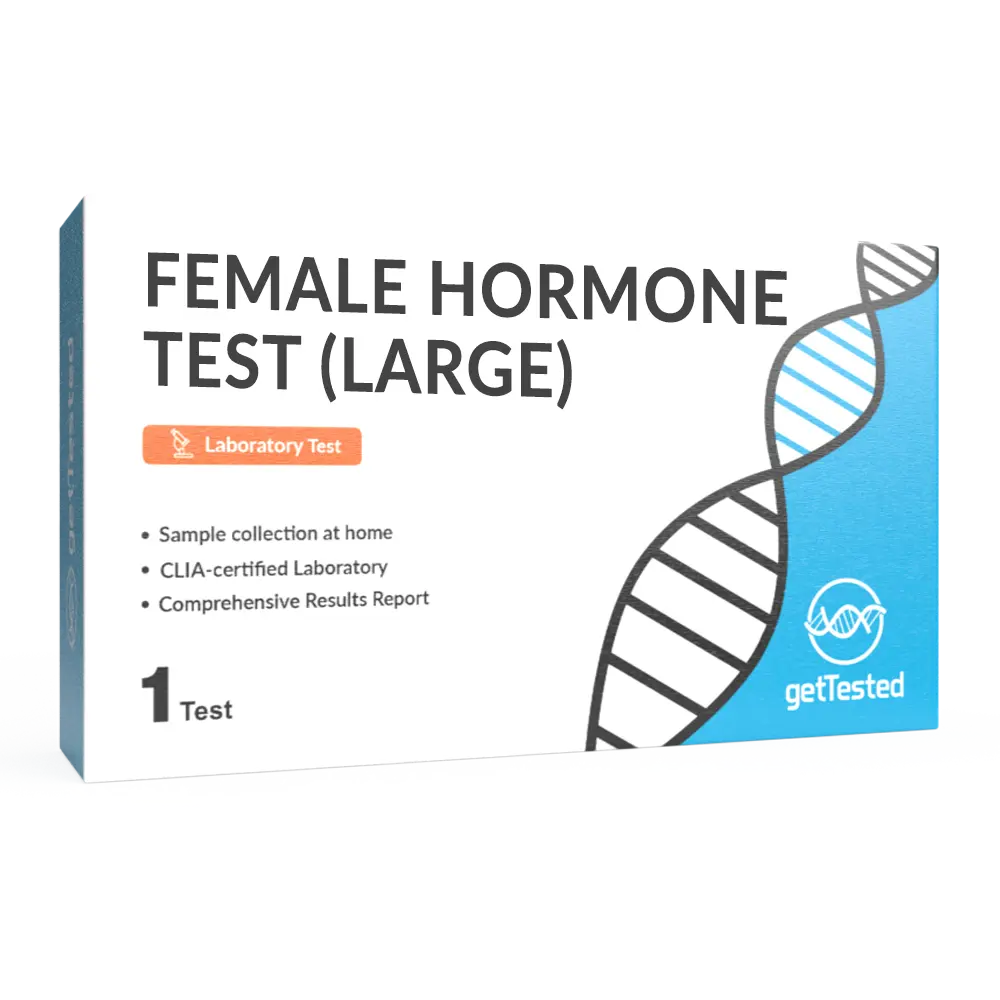
Female Hormone Test (Large)

GetTested’s Female Hormone Test (Large) is an expanded at-home saliva hormone panel measuring Estradiol (E2), Estrone (E1), Estriol (E3), Progesterone, Testosterone, DHEA-S, and morning cortisol (30 minutes after waking).
By including all three primary estrogens alongside adrenal and androgen markers, the test provides a more complete view of estrogen levels and overall hormone balance. Different estrogen forms may be more prominent at different stages of life, making this test relevant across hormonal transitions, including during reproductive years and perimenopause.
Samples are collected at home using saliva and analyzed using LC-MS/MS, a highly precise laboratory method for hormone measurement, with results delivered digitally.
Approved for New York residents.
$239.00
HSA & FSA eligibleAbout Female Hormone Test (Large)
What your hormone markers can indicate
Hormone levels are influenced by several interconnected systems, including reproductive hormones and the body’s stress response.
Estrogen levels are represented by three different forms—estradiol (E2), estrone (E1), and estriol (E3)—which may vary in relation to overall hormone balance and across different stages of life, including during reproductive years, cycle changes, and hormonal transitions such as perimenopause and menopause. Progesterone and testosterone provide additional context to hormonal patterns, while DHEA-S and cortisol reflect aspects of the body’s stress response and daily rhythm.
Changes in these hormone patterns may be relevant when exploring factors such as energy levels, mood, sleep, or overall hormonal balance.
What This Test Measures
Biomarkers
7 biomarkers
Sample
Saliva
Results in
Digitally within 5-10 business days after sample receipt.
Format
Lab Test
How It Works
You collect saliva samples at home, including a morning sample taken 30 minutes after waking. The samples are then sent to a CLIA-certified laboratory for analysis, and your results are delivered digitally once testing is complete.
Saliva Collection
The test uses saliva samples collected at home.
This non-invasive method allows for hormone measurements at specific time points, including the morning cortisol sample, which reflects the early part of the body’s daily rhythm.
Have Questions?
Chat with our AI assistant for instant answers about this product, usage, or recommendations.
Over 500,000 Customers
4.6 out of 5 based on 5 reviews on this product
$239.00
Female Hormone Test (Large)
GetTested’s Female Hormone Test (Large) is an expanded at-home saliva hormone panel measuring Estradiol (E2), Estrone (E1), Estriol (E3), Progesterone, Testosterone, DHEA-S, and morning cortisol (30 minutes after waking).
By including all three primary estrogens alongside adrenal and androgen markers, the test provides a more complete view of estrogen levels and overall hormone balance. Different estrogen forms may be more prominent at different stages of life, making this test relevant across hormonal transitions, including during reproductive years and perimenopause.
Samples are collected at home using saliva and analyzed using LC-MS/MS, a highly precise laboratory method for hormone measurement, with results delivered digitally.
Approved for New York residents.
$239.00
HSA & FSA eligibleWhat your hormone markers can indicate
Hormone levels are influenced by several interconnected systems, including reproductive hormones and the body’s stress response.
Estrogen levels are represented by three different forms—estradiol (E2), estrone (E1), and estriol (E3)—which may vary in relation to overall hormone balance and across different stages of life, including during reproductive years, cycle changes, and hormonal transitions such as perimenopause and menopause. Progesterone and testosterone provide additional context to hormonal patterns, while DHEA-S and cortisol reflect aspects of the body’s stress response and daily rhythm.
Changes in these hormone patterns may be relevant when exploring factors such as energy levels, mood, sleep, or overall hormonal balance.
What This Test Measures
Biomarkers
7 biomarkers
Sample
Saliva
Results in
Digitally within 5-10 business days after sample receipt.
Format
Lab Test
How It Works
You collect saliva samples at home, including a morning sample taken 30 minutes after waking. The samples are then sent to a CLIA-certified laboratory for analysis, and your results are delivered digitally once testing is complete.
Saliva Collection
The test uses saliva samples collected at home.
This non-invasive method allows for hormone measurements at specific time points, including the morning cortisol sample, which reflects the early part of the body’s daily rhythm.
How accurate are at-home saliva hormone tests compared to blood tests?
What hormones does this saliva hormone test measure, and why are they important?
How do I collect the saliva sample correctly for this at home hormone test, and what should I avoid before testing?
What is LCMS hormone testing saliva, and why is it used for hormone analysis?
Female Hormone Test (Large) price and what’s included
Price history
Current price
$239.00
Starting price
$239.00
Total change
$0.00
No. of changes
0
Stable Pricing
No hidden fees. The price you see is the price you pay.
Price Lock Guarantee
Your price won't change after purchase.
Have Questions About This Product?
Chat with our AI assistant for instant answers about this product, usage guidelines, or personalized recommendations.
Over 500,000 Customers
4.6 out of 5 based on 5 reviews on this product