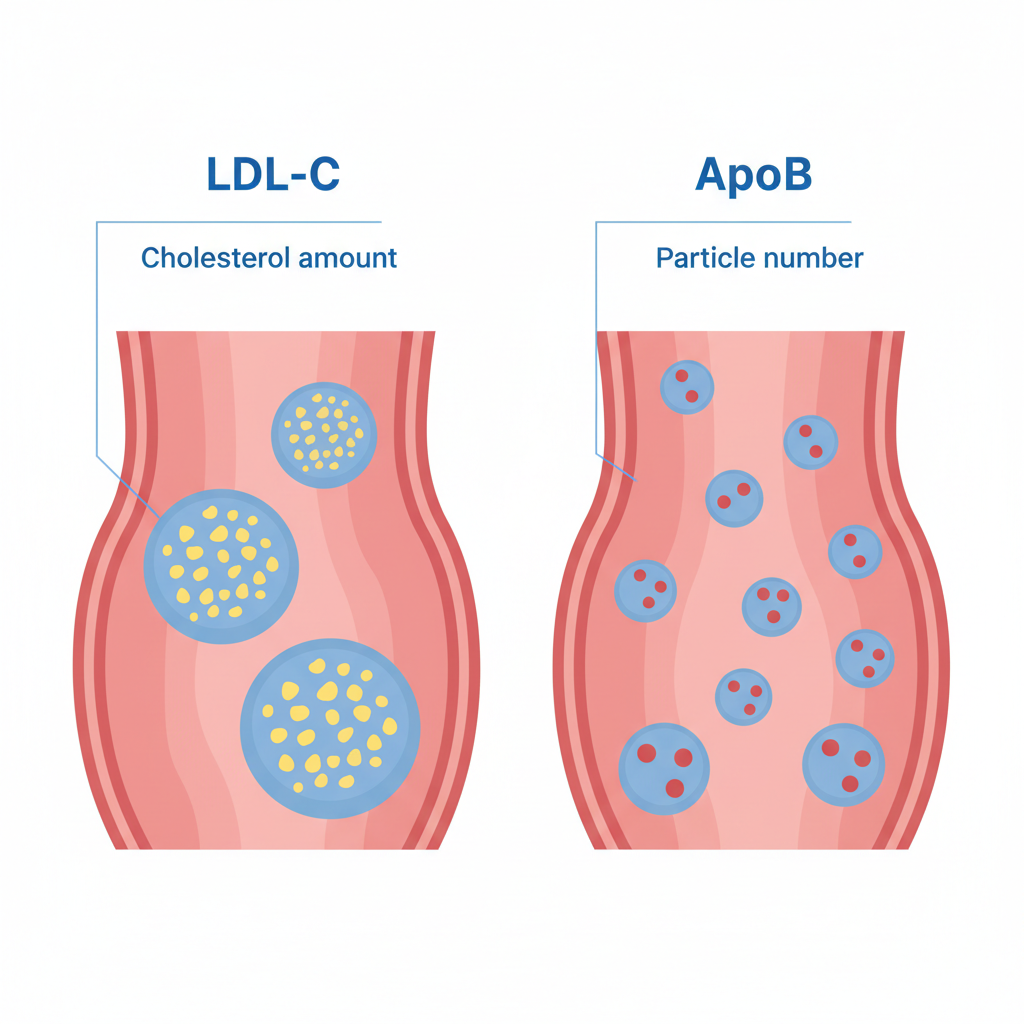

ApoB, short for apolipoprotein B, is a protein found on the surface of certain cholesterol-carrying particles in your blood. It helps these particles move fat and cholesterol through the body. But ApoB is more than just a transport protein. It can also give important insight into your cardiovascular risk.
Many people are used to hearing about LDL cholesterol, often called “bad cholesterol.” But LDL cholesterol only tells you how much cholesterol is carried inside LDL particles. ApoB gives a different kind of information: it reflects how many potentially artery-clogging particles are circulating in your blood. That is why ApoB is increasingly seen as one of the most useful markers for understanding heart disease risk.
What is ApoB?
ApoB is a structural protein found on lipoproteins that carry cholesterol and triglycerides through the bloodstream. These include LDL, VLDL, IDL, and other particles involved in fat transport. Each of these particles usually carries one ApoB protein, which means ApoB can act like a particle count.
A simple way to understand this is to imagine cholesterol as cargo and LDL particles as trucks. LDL cholesterol tells you how much cargo is being carried. ApoB tells you how many trucks are on the road. If there are too many trucks, the chance of traffic problems increases, even if each truck is not carrying a huge load.
This matters because heart disease is not only about how much cholesterol is in the blood. It is also about how many cholesterol-carrying particles are moving through the arteries and how likely they are to enter the artery wall.
ApoB vs LDL cholesterol: what is the difference?
LDL cholesterol, often written as LDL-C, measures the amount of cholesterol inside LDL particles. ApoB measures the number of ApoB-containing particles, including LDL and other atherogenic particles. “Atherogenic” means they can contribute to plaque buildup in the arteries.
For many people, LDL cholesterol and ApoB move in the same direction. If LDL cholesterol is high, ApoB is often high too. But not always. Some people can have normal or only mildly elevated LDL cholesterol while still having a high number of LDL particles. In that situation, ApoB may reveal a risk that a standard cholesterol reading does not fully show.
This is why ApoB can be so revealing. Two people can have the same LDL cholesterol level, but one may have many small cholesterol-carrying particles, while the other has fewer larger particles. The person with more particles may have a higher ApoB level and potentially a higher cardiovascular risk, even if their LDL cholesterol looks similar on paper.
Why ApoB may matter more than LDL cholesterol
ApoB matters because plaque formation begins when atherogenic particles enter the artery wall. The more ApoB-containing particles you have in circulation, the more opportunities those particles have to interact with the artery lining. Over time, this can contribute to atherosclerosis, which is the buildup of fatty plaque inside the arteries.
LDL cholesterol is still important. It remains one of the most widely used markers for assessing heart health. But ApoB can provide a more direct view of particle number, which may make it especially useful when traditional cholesterol results do not tell the full story.
This can be relevant for people with insulin resistance, metabolic syndrome, type 2 diabetes, high triglycerides, abdominal weight gain, or a family history of heart disease. In these cases, LDL cholesterol may not always reflect the true number of cholesterol-carrying particles in the blood.
What does a high ApoB mean?
A high ApoB level generally means there is a higher number of atherogenic lipoprotein particles in the bloodstream. These particles can include LDL, VLDL remnants, and other cholesterol-rich particles that may contribute to plaque formation.
ApoB does not diagnose heart disease on its own. Instead, it gives another layer of information about cardiovascular risk. It is most useful when interpreted together with other markers such as LDL cholesterol, HDL cholesterol, triglycerides, total cholesterol, non-HDL cholesterol, Lp(a), blood pressure, blood sugar, inflammation markers, lifestyle factors, and family history.
If you want to measure ApoB together with other cholesterol-related markers, the Cholesterol & Lipid Test can be a relevant option. It is especially useful if you want more detail than a basic cholesterol reading and want to understand markers such as ApoB, Lp(a), LDL cholesterol, HDL cholesterol, triglycerides, and total cholesterol in context.
Is ApoB useful if your LDL cholesterol is normal?
Yes, ApoB can be useful even if your LDL cholesterol is within range. This is because LDL cholesterol and ApoB answer different questions. LDL cholesterol asks, “How much cholesterol is being carried?” ApoB asks, “How many potentially harmful particles are carrying it?”
This difference can matter when cholesterol is distributed across many smaller particles. In that case, LDL cholesterol may not look especially high, but ApoB may still be elevated. That can suggest that the arteries are being exposed to more atherogenic particles than expected.
This is one reason ApoB is often discussed in relation to “hidden” cardiovascular risk. It does not replace LDL cholesterol, but it can make the picture clearer.
How ApoB fits into a full heart health picture
ApoB is powerful, but it is not the only marker that matters. Heart health is influenced by several systems at once: lipid metabolism, inflammation, blood sugar regulation, blood pressure, genetics, smoking, exercise, sleep, and diet quality.
For example, LDL and ApoB help explain cholesterol particle risk, while hs-CRP can provide information about low-grade inflammation. Inflammation does not mean plaque is present, but it can help show whether the body is under inflammatory stress, which may be relevant when assessing cardiovascular risk more broadly.
If you want to look beyond cholesterol alone, the Heart Health Test – Lipids & Inflammation may be useful because it combines lipid-related markers with inflammation context. This can help create a broader view of cardiovascular health than cholesterol markers alone.
For someone who mainly wants a traditional cholesterol overview, the Cholesterol Test – Full Lipid Profile may be the more straightforward option. A full lipid profile typically helps assess total cholesterol, LDL cholesterol, HDL cholesterol, and triglycerides, which are still central markers in heart health screening.
Who may benefit from testing ApoB?
ApoB testing may be especially helpful for people who want a deeper understanding of cardiovascular risk. This includes people with a family history of heart disease, high triglycerides, insulin resistance, diabetes, metabolic syndrome, or previous cholesterol results that feel confusing or incomplete.
It may also be useful if your LDL cholesterol does not seem to match your overall risk profile. For example, someone may have “okay” LDL cholesterol but still have other risk factors, such as elevated triglycerides, low HDL cholesterol, high blood pressure, or a strong family history of early heart disease.
Testing ApoB can help turn a vague concern into more specific information. Instead of only asking whether cholesterol is “high” or “normal,” ApoB helps ask a better question: how many atherogenic particles are circulating in the blood?
Can ApoB be lowered?
ApoB can often be influenced by the same strategies used to improve overall lipid health. These may include eating more fiber-rich foods, improving the quality of dietary fats, reducing excess saturated fat, exercising regularly, maintaining a healthy weight, limiting smoking, and managing blood sugar. For some people, medication may also be needed, especially when cardiovascular risk is higher or genetic factors are involved.
The most important point is that ApoB should not be interpreted in isolation. A high result is a signal to look more closely at your cardiovascular risk profile and discuss next steps with a healthcare professional.
Conclusion
ApoB is one of the most useful markers for understanding cholesterol-related cardiovascular risk because it reflects the number of atherogenic particles in the blood. LDL cholesterol tells you how much cholesterol is carried inside LDL particles, while ApoB helps show how many potentially harmful particles are present.
That difference can matter. In some people, ApoB may reveal risk that standard LDL cholesterol does not fully capture. If you want a clearer picture of your heart health, testing ApoB alongside a full lipid profile and other relevant markers can provide more meaningful insight than looking at LDL cholesterol alone.
Disclaimer: This article is for educational purposes only and does not constitute medical advice. Always consult with a healthcare professional before making changes to your health regimen.