
Medications, Supplements and Exercise: Effects on Liver Enzymes
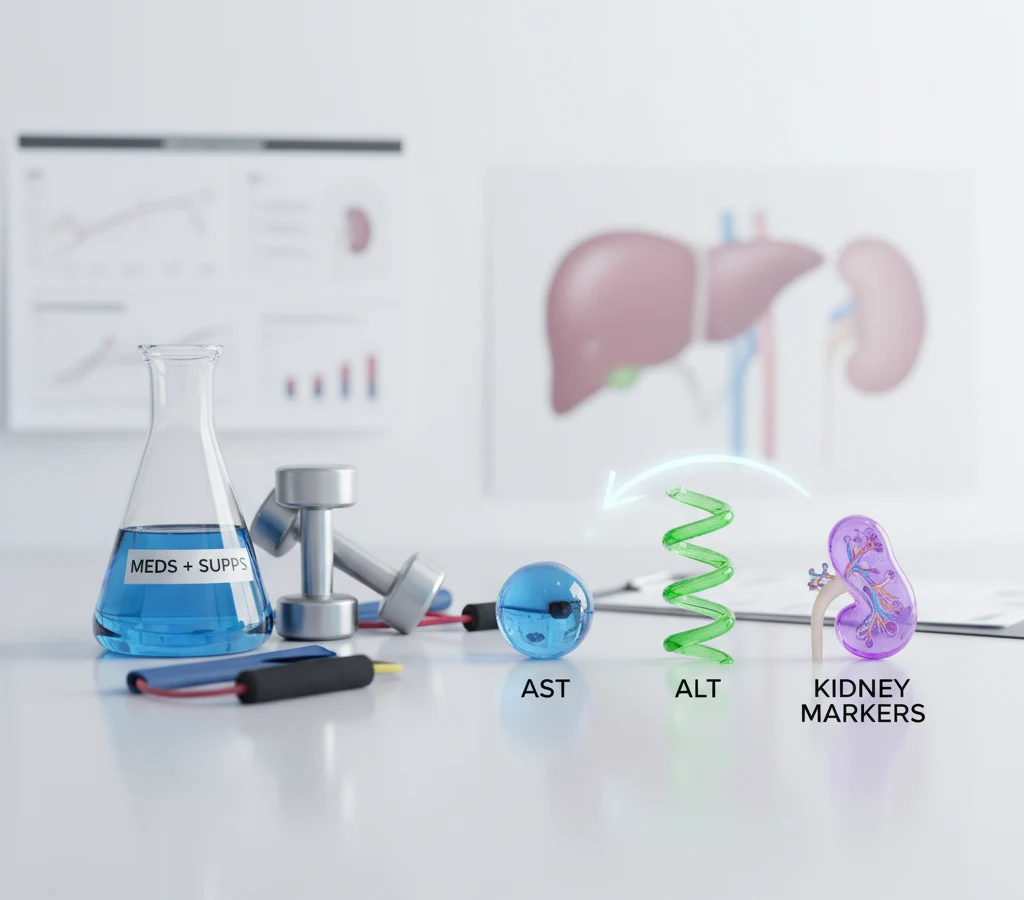
Medications, food supplements and strenuous exercise can all influence liver blood tests—but they do not affect them in the same way. Some substances cause liver injury, while a hard workout can release enzymes from muscle rather than liver. Kidney results can also change because of dehydration, medicines, supplement ingredients or muscle breakdown.
Relevant GetTested tests, such as the Kidney Function Test and Liver Function Test, are analyzed in CLIA-certified, CAP-accredited laboratories and are HSA/FSA eligible — check with your plan administrator.
The key is to interpret the results alongside symptoms, previous measurements and a complete exposure history. An abnormal result is a reason to investigate, not proof that a particular medicine, supplement or workout caused damage.
What do elevated liver enzymes actually mean?
Short answer: Elevated liver enzymes can signal irritation or injury, but they do not establish its cause or directly measure how well the liver works. AST can come from muscle as well as liver; ALT is more liver-associated but is not completely liver-specific.
- Evidence: Liver blood tests measure different processes. ALT and AST primarily indicate cell injury, while alkaline phosphatase, bilirubin, albumin and clotting tests provide other information.
- Exceptions: Significant liver health conditions can exist with normal or only mildly elevated enzymes. Conversely, high AST or ALT after muscle injury does not necessarily mean a liver health condition.
- Sample type: Usually venous blood in clinical practice; collection methods for home tests vary.
- Medical source: MedlinePlus: Liver Function Tests.
ALT means alanine aminotransferase, and AST means aspartate aminotransferase. Both are enzymes found inside cells. When cells are injured, these enzymes can enter the bloodstream. AST is present in substantial amounts in skeletal muscle, making recent exercise particularly relevant.
Other measurements help explain the pattern. Alkaline phosphatase, or ALP, may rise with bile-duct problems, but it also comes from bone. Gamma-glutamyl transferase, or GGT, can help identify a liver source of raised ALP. Bilirubin reflects processing and excretion of a breakdown product of red blood cells. Albumin and the international normalised ratio, or INR, can help assess liver synthetic function, although other conditions also affect them. Doctors use these values to reach a diagnosis.
Always compare results with the reporting laboratory’s reference range. A single number, or the AST-to-ALT ratio alone, cannot reliably distinguish medication effects, alcohol-associated injury, metabolic liver health conditions and muscle injury.
Can medications cause high liver enzymes?
Short answer: Yes. Prescription and over-the-counter medicines can raise liver enzymes, ranging from mild, temporary changes to uncommon but serious drug-induced liver injury.
- Evidence: Clinical guidance recognises both predictable, dose-related injury and less predictable reactions occurring in susceptible individuals.
- Exceptions: An elevation during treatment does not prove the medicine caused it. Mild abnormalities do not automatically require stopping an effective treatment.
- Sample type: Venous blood for liver chemistry; bilirubin and INR may be needed when clinically important injury is suspected.
- Medical source: AASLD practice guidance on drug, herbal and dietary supplement–induced liver injury and FDA: Acetaminophen.
Examples of medicines associated with liver injury include certain antibiotics, anti-tuberculosis medicines, antiseizure medicines and health condition treatments. These associations do not mean everyone taking them needs the same monitoring schedule. The medicine, dose, treatment duration, medical history and symptoms determine the appropriate approach.
Paracetamol, also called acetaminophen, requires particular care. Taking too much can cause severe liver injury. Accidental excess can occur when someone combines a pain reliever with a cold, flu or prescription combination product containing the same ingredient. Follow the label or prescriber’s directions, and check active ingredients rather than relying on brand names.
Statins illustrate why interpretation matters. Small enzyme increases can occur, but serious liver injury is rare. Liver-test monitoring should follow the specific statin’s locally approved product information and applicable national guidance. Testing may be recommended before treatment, after initiation or dose changes, and when symptoms suggest liver injury. Your prescriber should determine the schedule. Stable chronic liver health conditions do not automatically rule out statin treatment.
Medication-related injury often develops within days to months, although some reactions occur later or become apparent after treatment ends. A clinician will review start dates, dose changes, previous exposure and what happened after withdrawal. There is usually no single test that proves a medicine is responsible.
Do not stop an essential prescription solely because a result is outside the reference range. Contact the prescriber promptly for a medication-specific decision. Suspected overdose or symptoms of a serious health condition require urgent assessment rather than waiting for routine advice.
Can supplements affect liver and kidney function?
Short answer: Yes. Some food supplements can injure the liver or kidneys, interact with medicines, or change laboratory results without causing organ damage.
- Evidence: AASLD recognises herbal and dietary supplements as causes of liver injury. NIH guidance also documents kidney risks from excessive intake of certain nutrients, including vitamin D.
- Exceptions: Risk depends on the ingredient, dose, formulation and individual. A supplement-related change in creatinine does not always represent reduced kidney filtration.
- Sample type: Venous blood for liver markers, creatinine and estimated glomerular filtration rate; urine may be needed to assess albumin or other kidney abnormalities.
- Medical source: AASLD supplement-related liver injury guidance and NIH Office of Dietary Supplements: Vitamin D.
“Natural” does not support a claim of absolute safety. Concentrated extracts can produce exposures very different from ordinary foods or beverages. Reported liver-injury associations include concentrated green tea extracts and some multi-ingredient health products. Products containing undeclared anabolic steroids can cause a distinctive pattern of bile-flow impairment and jaundice.
Multi-ingredient products are difficult to assess because formulations, batches and actual contents may differ. Using several products together also makes it harder to identify the responsible ingredient. Keep packaging, ingredient lists, batch numbers and purchase details if an adverse reaction is suspected.
Kidney risks differ. Excess vitamin D can cause high blood calcium and, in severe cases, kidney health issues. Some botanical ingredients and contaminants are directly toxic to kidneys. People with existing kidney health conditions may also have difficulty handling particular minerals or supplement ingredients.
Creatine needs a different interpretation. Creatine use, muscle mass and recent exercise can influence serum creatinine, the marker used in many estimated filtration calculations. A higher creatinine result is not, by itself, proof that creatine has injured the kidneys. When the result is difficult to interpret, a clinician may consider urine testing or a filtration estimate using cystatin C.
Share all supplements with your clinician or pharmacist, including powders, teas, pre-workout formulas and products used intermittently. Food supplements are not medicines. Do not exceed the recommended daily dose. Food supplements should not be used as a substitute for a varied and balanced diet and a healthy lifestyle. Keep out of reach of young children. These statements have not been evaluated by the Food and Drug Administration. This product is not intended to diagnose, treat, support health in place of medicine, or prevent any disease.
Can exercise cause elevated AST and ALT?
Short answer: Yes. Strenuous exercise, especially unfamiliar weightlifting or muscle-damaging activity, can temporarily increase AST and ALT because these enzymes can be released from skeletal muscle.
- Evidence: A small controlled study found that weightlifting increased AST, ALT and muscle-injury markers for at least seven days in healthy men.
- Exceptions: Exercise does not explain every abnormal result. Liver health conditions can coexist with training, and severe muscle breakdown can injure the kidneys.
- Sample type: Venous blood for AST, ALT, creatine kinase and kidney markers; urine testing may be needed if muscle breakdown is suspected.
- Medical source: Pettersson and colleagues: Muscular exercise can cause highly pathological liver function tests in healthy men.
The connection between exercise, AST and ALT is particularly important after resistance training, long endurance events, high-intensity sessions or a sudden increase in workload. Eccentric movements—such as lowering a heavy weight or downhill running—can produce substantial muscle stress.
In the weightlifting study, AST, ALT, creatine kinase and myoglobin increased, while bilirubin, GGT and ALP remained within normal ranges. That pattern supported muscle as the main source. However, the study was small and involved healthy men, so it does not establish a universal recovery period for every person or sport.
Creatine kinase, or CK, helps assess muscle injury. A raised CK alongside recent strenuous exercise supports a muscle contribution, but neither CK nor a normal GGT definitively excludes a liver health condition. The size of the increase, symptoms and changes over time all matter.
For an otherwise well person with a plausible exercise-related elevation, a clinician may suggest repeating testing after about a week without strenuous activity; some people need longer. This is not a reason to stop ordinary physical activity indefinitely, and it is not appropriate to delay care when symptoms or results suggest a significant health condition.
How can clinicians distinguish medication, supplement and exercise effects?
Short answer: They combine the timing of exposures with the laboratory pattern, symptoms and follow-up results. Other common causes must be considered rather than assuming the newest medicine or hardest workout is responsible.
- Evidence: AASLD guidance describes drug-induced liver injury as a clinical diagnosis requiring assessment of competing explanations.
- Exceptions: Several causes may occur together. Normal initial results or improvement after rest do not necessarily exclude an underlying health condition.
- Sample type: Usually venous blood; additional investigations may include urine testing, liver ultrasound and targeted viral or autoimmune tests.
- Medical source: AASLD practice guidance on drug-induced liver injury.
A useful review includes all prescription medicines, nonprescription products, alcohol intake, supplements, recent health conditions and exercise during the preceding days and weeks. Bring earlier laboratory results whenever possible. Long-standing mild elevations require a different assessment from a sudden increase after a new exposure.
Clinicians consider whether the pattern mainly involves ALT and AST, bile-duct-associated markers, or both. They may check CK when muscle injury is plausible and bilirubin or INR when the severity of liver injury is uncertain. Kidney assessment becomes particularly important with dehydration, muscle breakdown or medicines that affect kidney blood flow.
Other explanations can include metabolic dysfunction-associated steatotic liver health conditions, alcohol-associated liver health conditions, viral hepatitis, gallstones and autoimmune health conditions. An ultrasound or additional blood tests may be more useful than repeatedly ordering the same basic panel.
Marked elevations—particularly values several times the upper reference limit—deserve prompt clinical review. The exact urgency depends on symptoms, bilirubin, clotting results and the trajectory, not only the enzyme number. Do not deliberately restart a suspected substance to see whether the abnormality returns.
How should you prepare for repeat testing, and can an at-home test help?
Short answer: Follow the test instructions, disclose recent exercise and all products you take, and agree on any changes with your clinician. Whether an at-home test is appropriate depends on its documented intended purpose and performance; results provide data to discuss with a healthcare provider and may need confirmation and additional investigations.
- Evidence: Liver and kidney assessments rely on the combination of test results and clinical context. Kidney evaluation may require both blood filtration markers and urine albumin testing.
- Exceptions: Home testing is not appropriate as the only assessment for suspected overdose, jaundice, severe muscle injury or acute kidney injury.
- Sample type: Clinical follow-up commonly uses venous blood and, when indicated, a spot urine sample. Home collection methods depend on the specific validated test.
- Medical source: NIDDK: Chronic Kidney health condition Tests & Diagnosis.
For a useful repeat measurement, document the date of your last hard workout, muscle soreness, alcohol use and recent dose changes. If your clinician recommends a rest interval, avoid strenuous exercise for the agreed period. Maintain usual hydration rather than deliberately drinking excessive water.
Fasting is not automatically required for every liver or kidney panel; follow the instructions for the specific tests ordered. Do not omit prescribed doses or stop treatment simply to obtain a lower result. Suspected supplement-related injury warrants clinical advice rather than using repeat home tests to decide whether continued use is safe. You should check with your plan administrator regarding HSA/FSA eligibility for at-home kits.
A liver panel may not include CK or INR, and a kidney blood panel may not include urine albumin. No basic panel can independently establish that a medication or supplement is safe for you.
Product-information limitation: The linked Liver Function Test (analyzed in a CLIA-certified, CAP-accredited laboratory; HSA/FSA eligible — check with your plan administrator), Liver & Kidney Function Test (analyzed in a CLIA-certified, CAP-accredited laboratory; HSA/FSA eligible — check with your plan administrator) and Kidney Function Test (analyzed in a CLIA-certified, CAP-accredited laboratory; HSA/FSA eligible — check with your plan administrator) pages are US-market references, not EU test recommendations. Their current biomarkers, collection methods, intended users and purposes, supporting performance evidence, and applicable EU conformity and availability have not been verified for this article. No product-specific clinical-use recommendation is made. Before publication with any such recommendation, these details must be substantiated and the corresponding EU-market pages used where available. Screening tests are not food supplements.
When do abnormal liver enzymes or exercise-related symptoms need urgent care?
Short answer: Seek urgent assessment for jaundice, confusion, severe abdominal pain, persistent vomiting, markedly reduced urine, or severe muscle symptoms after exercise. A possible paracetamol overdose needs immediate advice even if you feel well.
- Evidence: Serious liver injury can affect clotting and mental function. Rhabdomyolysis can cause kidney injury and dangerous electrolyte disturbances.
- Exceptions: Early overdose and significant laboratory abnormalities may cause few symptoms; feeling well does not reliably exclude danger.
- Sample type: Urgent clinical blood testing may include liver chemistry, INR, creatinine, electrolytes and CK, with urine testing as indicated.
- Medical source: CDC/NIOSH: Signs and Symptoms of Rhabdomyolysis and FDA: Acetaminophen.
After intense exercise, muscle pain or weakness that is more severe than expected—especially with tea- or cola-coloured urine—requires prompt evaluation. Dark urine has several possible causes and should not be dismissed as dehydration. Rhabdomyolysis can also occur without visibly dark urine.
For suspected poisoning or medication overdose, contact your local poison centre or seek immediate emergency medical advice, even if you feel well. In the EU, call 112 for collapse, seizures, difficulty breathing or inability to awaken. Do not wait for an at-home test or symptoms to develop.
Bottom line: Medicines, supplements and exercise can all affect liver enzymes, but the same result can have very different explanations. A complete exposure history, appropriately selected tests and timely clinical follow-up are more informative than interpreting AST or ALT in isolation.
This article is for general information and is not a substitute for professional medical advice. Talk to a healthcare provider about your results.