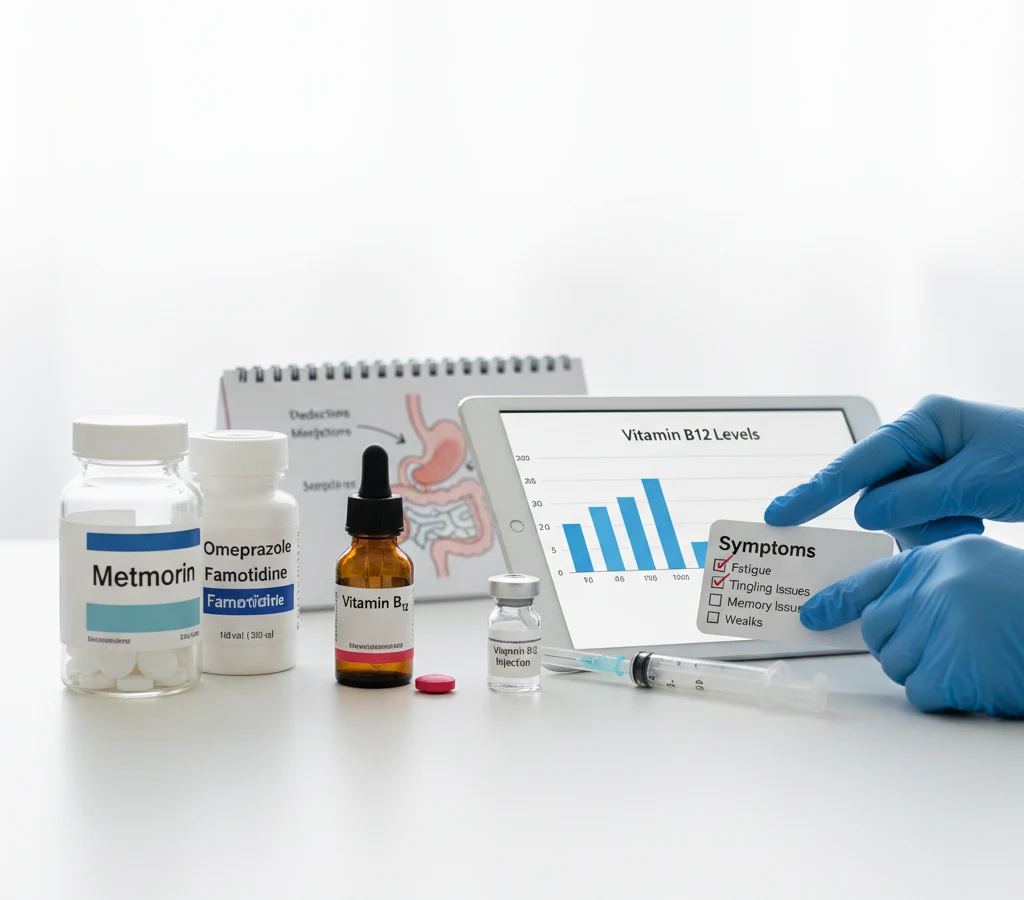

Can medications cause vitamin B12 deficiency?
Short answer: Yes. Some medicines can reduce vitamin B12 absorption, including metformin and acid-suppressing drugs, but taking one does not automatically mean you have a deficiency.
- Evidence: The National Institutes of Health identifies metformin, proton pump inhibitors and H2-receptor antagonists as medicines that can interfere with vitamin B12 absorption or status.
- Exceptions: Low B12 can also reflect inadequate intake, autoimmune gastritis, gastrointestinal surgery or other absorption problems. Medication may be only one contributing factor.
- Sample type: Blood; serum or plasma B12 testing commonly uses a venous blood sample.
- Relevant test: The Vitamin B12 Test measures the nutrient relevant to this concern. Check the product instructions for its specific collection method (analyzed in a CLIA-certified, CAP-accredited laboratory; HSA/FSA eligible — check with your plan administrator).
- Medical source: NIH Office of Dietary Supplements: Vitamin B12.
Vitamin B12 supports normal red blood cell formation and normal nervous system function. In food, it is usually attached to protein. Stomach acid helps release it, after which several digestive steps allow absorption in the small intestine.
Medicines can interfere with different parts of that process. Acid-suppressing drugs primarily affect the release of food-bound B12. Metformin appears to interfere with intestinal uptake through mechanisms that are not completely understood.
Because the body stores substantial amounts of B12, changes often develop gradually. A low result does not prove a medicine caused it, and a recent prescription does not necessarily explain an existing deficiency. The useful next step is a review of symptoms, diet, medication exposure and laboratory findings—not stopping medication on your own.
Can metformin cause vitamin B12 deficiency?
Short answer: Yes. Long-term metformin use can lower vitamin B12 levels, with greater risk generally associated with longer use and higher doses.
- Evidence: A randomized trial found that metformin lowered B12 concentrations and increased the absolute risk of biochemical B12 deficiency by about 7 percentage points compared with placebo over 4.3 years.
- Exceptions: Not everyone taking metformin develops deficiency. Trial results do not predict an individual’s risk, particularly across different doses, diets and starting B12 levels.
- Sample type: Blood for B12; additional venous blood tests may include a complete blood count and methylmalonic acid.
- Relevant test: The Vitamin B12 Test provides results to discuss with a healthcare provider regarding metformin B12 monitoring.
- Medical source: de Jager and colleagues, BMJ: Long-term metformin treatment and risk of vitamin B12 deficiency.
The metformin–B12 link is supported by more than observational associations. In the randomized trial, participants had diabetes and were receiving insulin; the metformin dose was 850 mg three times daily. This context matters: the findings should not be interpreted as the exact risk for everyone taking a lower dose or using metformin for a different indication.
Long-term follow-up from the study regarding blood sugar management also linked metformin exposure with lower B12 status (Aroda and colleagues, 2016: Long-term Metformin Use and Vitamin B12 Deficiency in the blood sugar management program Outcomes Study). Together, these findings support paying attention to B12 during ongoing use rather than assuming that an adequate diet eliminates the risk.
This is especially important when someone with diabetes develops tingling or numbness. Those symptoms may be attributed to nerve challenges related to blood sugar, but B12 deficiency is another possible explanation, and both can coexist.
Metformin can remain an appropriate medicine despite a low B12 result. A clinician can evaluate B12 status and determine next steps without automatically withdrawing a useful prescription.
Can acid reflux medications cause vitamin B12 deficiency?
Short answer: Long-term use of proton pump inhibitors or H2 blockers can contribute to low B12, particularly when other risk factors are present. The evidence is mainly observational and does not mean everyone taking reflux medication needs routine testing.
- Evidence: A large case-control study associated at least two years of PPI use with higher odds of B12 deficiency; the association was smaller for H2 blockers. Gastroenterology guidance does not recommend routine B12 monitoring for PPI users without other risk factors.
- Exceptions: Occasional antacid use is not equivalent to years of daily acid suppression. Studies cannot fully separate medication effects from diet, age and underlying health conditions.
- Sample type: Blood for B12 assessment when clinically indicated.
- Relevant test: The Vitamin B12 Test can screen for levels when symptoms or additional risks justify checking B12.
- Medical source: Lam and colleagues, JAMA: Acid-suppressing medications and B12 deficiency; American College of Gastroenterology GERD guideline.
Proton pump inhibitors, or PPIs, include omeprazole, esomeprazole, lansoprazole and pantoprazole. H2 blockers include famotidine. Both reduce stomach acid, although through different mechanisms.
Lower stomach acidity can make it harder to release B12 from food proteins. B12 in fortified foods and food supplements is already in a free form, so it does not require this initial release step. However, other absorption problems may still be relevant.
In the JAMA study, two or more years of PPI exposure was associated with an odds ratio of 1.65 for B12 deficiency. This does not mean that 65% of users became deficient. It describes relative odds in an observational study, not an individual’s absolute likelihood.
The practical message about PPI B12 deficiency is balanced: review prolonged use when appropriate, but do not stop a medically indicated PPI because of this association alone.
Who is most likely to need a B12 assessment while taking these medicines?
Short answer: Assessment is more useful when medication exposure occurs alongside symptoms, a previous low result, limited dietary B12 or a condition affecting absorption. Taking both metformin and an acid-suppressing medicine is also worth mentioning to your clinician.
- Evidence: NIH guidance identifies older adults, people with gastrointestinal disorders or surgery, people with anemia due to absorption issues and those avoiding animal foods as groups at increased risk of inadequate B12 status.
- Exceptions: Risk factors do not establish a doctor's diagnosis, and people without obvious risk factors can still have deficiency.
- Sample type: Blood; further investigations depend on the suspected cause.
- Relevant test: The Vitamin B12, Folate & Homocysteine Test measures related markers, although homocysteine is not specific for B12 deficiency (analyzed in a CLIA-certified, CAP-accredited laboratory; HSA/FSA eligible — check with your plan administrator).
- Medical source: NIH Office of Dietary Supplements: Groups at risk of vitamin B12 inadequacy.
Factors to discuss include a vegan or highly restricted diet without reliable fortified foods, older age, bariatric surgery, stomach surgery and disorders affecting the terminal ileum, where B12 is absorbed. Autoimmune gastritis can reduce intrinsic factor, the protein needed for normal B12 absorption.
Long medication duration, a higher metformin dose and a low-normal previous B12 result can make monitoring more relevant. Using metformin and a PPI together gives a clinician additional context, but there is no simple formula that reliably calculates the combined risk.
Do not assume diet is the only issue. Someone who regularly eats animal products can still have low B12 because intake and absorption are different things.
What symptoms could suggest medication-related B12 deficiency?
Short answer: Possible symptoms include unexplained fatigue, a sore tongue, tingling, numbness, balance changes and difficulty concentrating. Neurological symptoms can occur without anemia, so a normal blood count does not rule out B12 deficiency.
- Evidence: NIH and clinical guidance describe both blood-related and neurological manifestations, including sensory changes and gait problems.
- Exceptions: These symptoms have many other causes. Diabetes, thyroid health conditions, anemia, nerve compression and medication effects may produce overlapping problems.
- Sample type: Blood for B12 and a complete blood count, with additional investigations based on the examination.
- Medical source: NICE guideline NG239: Recognising and diagnosing vitamin B12 deficiency.
B12-related anemia may be associated with tiredness, palpitations or breathlessness. Neurological changes may be more subtle initially: altered sensation in the feet, trouble judging foot position or increasing unsteadiness.
Arrange prompt medical assessment for new or worsening numbness, weakness, walking difficulties or cognitive changes. Do not rely on an at-home test alone when these are present. Sudden one-sided weakness, speech difficulty, chest pain or severe breathlessness warrants emergency assessment rather than assuming B12 is responsible.
For people taking metformin, distinguishing nerve challenges related to blood sugar from other causes is particularly important. Symptoms and examination findings help a doctor determine which tests are appropriate; a B12 result is only one part of that assessment.
Which tests help identify vitamin B12 deficiency?
Short answer: A blood B12 measurement is commonly the starting point. If the result is borderline or does not match the symptoms, a clinician may add methylmalonic acid, a complete blood count or other investigations.
- Evidence: NIH describes methylmalonic acid, or MMA, as a sensitive marker that can help clarify B12 status when serum B12 is approximately 150–399 pg/mL.
- Exceptions: Laboratory methods and reference ranges differ. Kidney impairment can raise MMA, and homocysteine can rise for reasons other than B12 deficiency.
- Sample type: Serum or plasma for B12 and MMA; whole blood for a complete blood count. At-home collection methods must be checked against the individual test instructions.
- Relevant test: The Vitamin B12, Folate & Homocysteine Test measures those three markers, not MMA or a complete blood count.
- Medical source: NIH Office of Dietary Supplements: Assessing vitamin B12 status.
Serum B12: Many laboratories consider values below about 200–250 pg/mL subnormal, but no single cutoff answers every clinical question. Always use the reporting laboratory’s units and interpretation.
MMA: This substance can increase when B12 availability is insufficient. It is particularly useful for some borderline results, but kidney function affects its interpretation.
Homocysteine: An elevated result may accompany low B12, but folate status, kidney function and other factors can also influence it. It cannot identify the cause on its own.
Complete blood count: This can identify anemia and enlarged red blood cells, although neither finding is required for B12 deficiency.
Relevant GetTested tests are analyzed in CLIA-certified, CAP-accredited laboratories and are HSA/FSA eligible — check with your plan administrator.
Tell your clinician about recent B12 tablets, injections or multivitamins because they can change test results. Where possible, diagnostic blood samples should be collected before B12 replacement begins. Seek prompt medical assessment for neurological symptoms; a clinician may need to start replacement without waiting for test results. Do not wait for a home kit or delay clinician-directed treatment.
How often should B12 be checked when taking metformin or a PPI?
Short answer: There is no single testing interval suitable for everyone. Periodic assessment is reasonable for some long-term metformin users, while routine screening is generally unnecessary for PPI users with no symptoms or additional risk factors.
- Evidence: Medication-safety guidance recommends testing metformin users with suspected deficiency and considering periodic monitoring in people at increased risk. The ACG advises against routine B12 monitoring solely because someone takes a PPI when no other risk factors exist.
- Exceptions: New symptoms, anemia, a previous abnormal result or a major change in diet or gastrointestinal health can justify earlier testing.
- Sample type: Blood, using the tests appropriate to the clinical question.
- Medical source: MHRA: Metformin and reduced vitamin B12 levels; ACG GERD guideline.
A useful review considers how long you have taken the medicine, your dose, previous B12 values, symptoms and other risks. A baseline measurement may be helpful when existing risk factors are present, but it is not automatically required before every prescription.
After an abnormal result, follow-up timing depends on its severity, the suspected cause and the clinician’s plan. Repeating a test without addressing these questions is less useful than agreeing on what the result will change.
What should you do if your B12 is low while taking these medicines?
Short answer: Review the result with your clinician and do not stop metformin or reflux medication on your own. The next steps depend on symptoms, how low the result is and whether medication is the only likely explanation.
- Evidence: Guidance emphasizes investigating the cause and reviewing clinical circumstances; necessary metformin therapy can often continue while B12 status is addressed.
- Exceptions: Progressive neurological symptoms require prompt clinical assessment rather than routine self-directed monitoring.
- Sample type: Blood for any confirmatory or follow-up investigations; no sample is needed for the medication review itself.
- Medical source: NICE NG239: Recommendations; MHRA metformin safety guidance.
Bring your medication list, doses, duration of use and any previous B12 results. Your clinician may assess dietary intake, review the ongoing need for acid suppression and investigate causes such as autoimmune gastritis or intestinal health conditions.
Depending on the findings, a clinician may discuss oral B12 or prescription injections. The appropriate route and monitoring plan depend on absorption, symptom severity and the underlying cause. An over-the-counter food supplement is not equivalent to a prescribed medicine or a substitute for assessment.
Avoid taking high-dose folic acid alone for unexplained anemia without discussing B12: folate can improve blood-related abnormalities while neurological consequences of B12 deficiency remain unrecognized.
If you use a food supplement, do not exceed the recommended daily dose. These statements have not been evaluated by the Food and Drug Administration. This product is not intended to diagnose, treat, or prevent any disease. Food supplements should not be used as a substitute for a varied and balanced diet and a healthy lifestyle. Keep out of reach of young children.
Bottom line: Metformin has a well-established association with lower B12; prolonged acid suppression may also contribute. The safest approach is targeted assessment based on symptoms and risk—not automatic testing for everyone or stopping useful medication.
Should people taking metformin or acid-reflux medicines test their B12?
Short answer: Metformin use is associated with lower B12 levels, particularly with longer use or higher doses; prolonged use of acid-suppressing medicines can also affect B12 absorption. Not everyone taking them needs the same testing schedule. Ask your prescriber about assessment if you develop fatigue, tingling or other concerns, or have additional risk factors.
Evidence: The NIH ODS B12 fact sheet summarizes interactions with metformin and gastric acid inhibitors.
Exceptions: Do not stop prescribed medication without advice. B12 symptoms overlap with other problems and the B12 result does not identify the cause of a low level. Seek prompt assessment for progressive numbness, weakness or balance changes.
Sample type: The linked US kit uses a mailed finger-prick dried blood spot; a clinician may choose venous testing and additional markers for an uncertain result.
Relevant test: GetTested Vitamin B12 Test. Medical source: NIH Office of Dietary Supplements, Vitamin B12.
This article is for general information and is not a substitute for professional medical advice. Talk to a healthcare provider about your results.