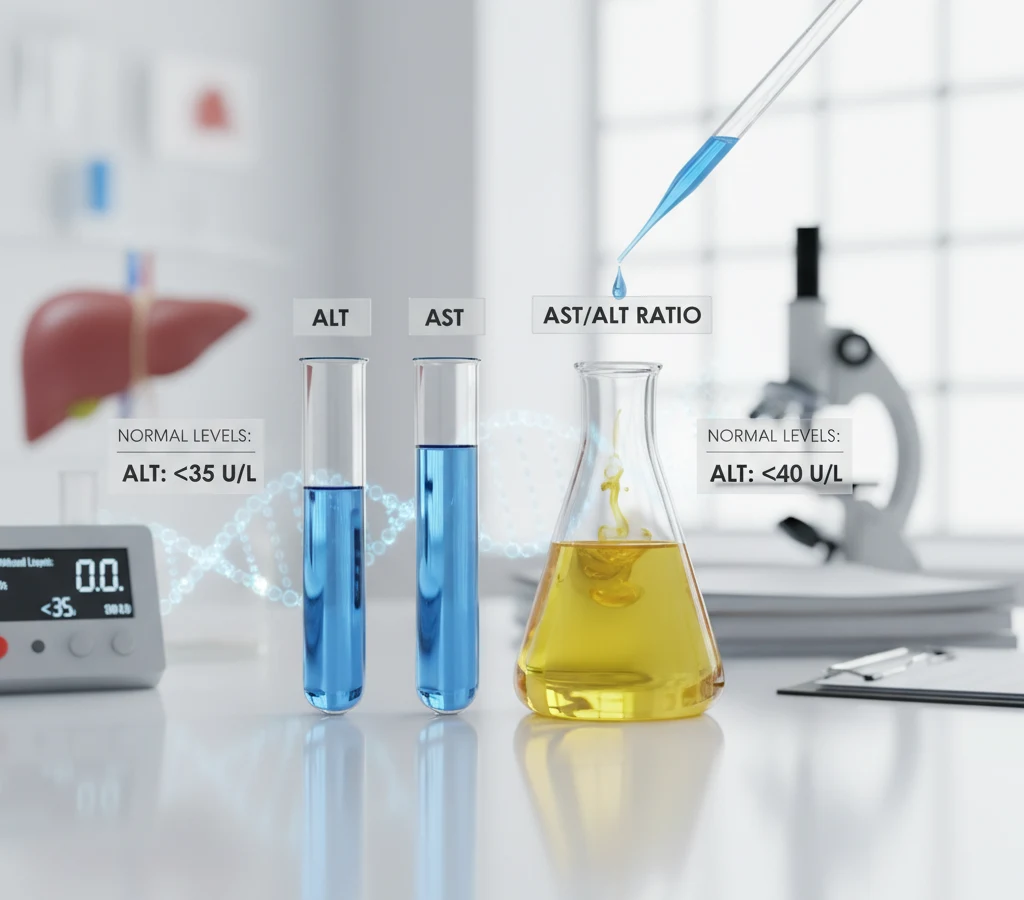

ALT and AST are enzymes commonly measured in a liver test. Raised levels can signal liver-cell injury, but they do not identify the cause or measure liver function directly. The most useful interpretation combines the individual results, the laboratory’s reference ranges, other blood tests, symptoms and changes over time.
Relevant GetTested tests are analyzed in CLIA-certified, CAP-accredited laboratories and are HSA/FSA eligible — check with your plan administrator.
AST vs ALT: What is the difference?
Short answer: ALT is more closely associated with the liver, while AST is also found in substantial amounts in muscle and other tissues. Both can rise with liver-cell injury, but an elevated AST result is less specific to the liver.
- Evidence: ALT and AST are aminotransferases: enzymes involved in amino-acid metabolism. Clinical guidelines interpret them as markers of cell injury rather than direct measurements of liver function.
- Exceptions: ALT is not exclusively liver-specific, and muscle injury can sometimes raise both enzymes. Normal results do not exclude every liver health condition.
- Sample type: Usually venous blood, with testing performed on serum or plasma.
- Relevant test: The Liver Function Test is analyzed in a CLIA-certified, CAP-accredited laboratory. Check the current biomarker list and collection instructions before ordering.
- Medical source: MedlinePlus: ALT blood test and AST test.
ALT stands for alanine aminotransferase. AST stands for aspartate aminotransferase. Older reports may call them SGPT and SGOT, respectively.
When cells are injured, more of these enzymes can enter the bloodstream. ALT is concentrated mainly in the liver. AST is present in the liver but also in skeletal muscle, the heart and other tissues. This explains why strenuous exercise or a muscle injury may affect AST without a primary liver problem.
Despite the familiar term “liver function tests,” ALT and AST mainly show injury. Albumin and the clotting measurement PT/INR provide information about the liver’s protein-making ability, while bilirubin helps assess its processing and excretory role. These measurements also have non-liver influences, so clinicians interpret the panel together.
What are normal ALT and AST levels?
Short answer: There is no single normal range that applies to everyone. Use the reference interval printed on your report, because ranges vary with the laboratory method, age, sex and reference population.
- Evidence: MedlinePlus gives example reference ranges of ALT 4–36 U/L and AST 8–33 U/L, while noting that laboratories may use different ranges. Specialist guidance also discusses lower healthy ALT thresholds than some laboratories use.
- Exceptions: Children may have different reference intervals. A result inside the laboratory range does not rule out chronic liver health conditions, and a small elevation does not provide a diagnosis.
- Sample type: Usually venous blood; use the reference interval supplied for the actual specimen and method.
- Relevant test: Review the Liver Function Test (HSA/FSA eligible — check with your plan administrator) for available liver markers and sampling requirements.
- Medical source: MedlinePlus: ALT blood test reference information and AST blood test reference information; ACG guideline on abnormal liver chemistries.
Results are usually reported in units per litre, or U/L. Another laboratory may use a higher upper limit than the examples above. That difference does not necessarily mean either laboratory is wrong. For HSA/FSA, you should check with your plan administrator.
The American College of Gastroenterology guideline describes healthy ALT values of approximately 29–33 U/L in men and 19–25 U/L in women. These are clinical assessment thresholds, not a replacement reference interval for every laboratory or a stand-alone diagnosis.
Clinicians often express an elevation as a multiple of the upper limit of normal, or ULN. If your laboratory’s ALT upper limit is 40 U/L, an ALT of 80 U/L is twice the ULN. This is more informative than comparing your raw number with someone else’s result from a different laboratory.
Trends also matter. A stable borderline result, a new result several times above the limit and a rapidly increasing result call for different assessments. However, neither a normal value nor a downward trend should be interpreted without the wider clinical picture.
High ALT levels: What do they mean?
Short answer: High ALT usually indicates liver-cell irritation or injury, but it does not reveal the cause or amount of permanent damage. Common explanations include metabolic dysfunction-associated steatotic liver health conditions, alcohol-related injury, and medication or supplement effects.
- Evidence: Guidelines recommend evaluating raised ALT according to its magnitude, persistence, symptoms, medical history and associated blood-test abnormalities.
- Exceptions: ALT can occasionally rise with muscle injury. Significant liver health conditions, including advanced scarring, can occur with normal or only mildly elevated ALT.
- Sample type: Venous blood for ALT and accompanying liver tests; additional investigations may require blood tests and imaging.
- Relevant test: A Liver Function Test can provide results to discuss with a healthcare provider, but cannot establish the cause by itself.
- Medical source: ACG Clinical Guideline: Evaluation of Abnormal Liver Chemistries.
One common explanation is metabolic dysfunction-associated steatotic liver health conditions, or MASLD, previously usually called non-alcoholic fatty liver health conditions. It is associated with cardiometabolic factors such as diabetes, excess abdominal fat and abnormal blood lipids. ALT alone cannot provide a diagnosis for it or determine whether liver scarring is present.
Other possible causes include:
- Alcohol exposure: The effect varies with drinking pattern, duration and individual susceptibility.
- Medicines and supplements: Prescription drugs, non-prescription medicines and some herbal or bodybuilding products can injure the liver.
- Less common conditions: Autoimmune hepatitis, iron overload, and alpha-1 antitrypsin deficiency may be considered according to age and clinical context.
- Acute health condition: Reduced blood flow to the liver and some bile-duct problems can cause substantial elevations.
The height of ALT does not directly measure the amount of fibrosis, or scar tissue. A person with a modest elevation may need assessment for chronic health conditions, while a much higher value may reflect an acute process with a different prognosis.
Do not stop prescribed medicines without advice. Give your clinician a complete list of medicines, food supplements, herbal products and recent dose changes so that possible contributors can be assessed safely.
High AST levels: What causes them?
Short answer: High AST can result from liver injury, but it can also come from muscle damage or other non-liver sources. An isolated AST elevation especially needs interpretation alongside ALT, symptoms, exercise history and sometimes a muscle enzyme test.
- Evidence: AST is distributed across several tissues. Guidelines recognise muscle injury as an important explanation for raised aminotransferases.
- Exceptions: AST higher than ALT does not prove alcohol-related health conditions. A damaged blood specimen can also affect the result.
- Sample type: Venous blood; creatine kinase, or CK, may be measured in blood when muscle injury is suspected.
- Relevant test: The Liver & Kidney Function Test is analyzed in a CLIA-certified, CAP-accredited laboratory. Check its listed markers; a separate CK test may be needed.
- Medical source: MedlinePlus: AST test; Guidelines on the management of abnormal liver blood tests.
Liver-related causes of high AST overlap with those of high ALT: metabolic liver health conditions, alcohol-related injury, medication effects and autoimmune conditions.
Non-liver explanations include recent strenuous exercise, muscle trauma, seizures and muscle disorders. Exercise-related elevations can persist for several days, so tell your clinician about unusual training or heavy lifting before the test.
Haemolysis, meaning red blood cell breakdown, is another consideration. It can occur in the body or during specimen collection and handling. A laboratory may flag a haemolysed sample and recommend a repeat collection.
Occasionally, persistent isolated AST elevation is caused by macro-AST, a circulating enzyme complex that is cleared slowly. This is an uncommon explanation considered after more likely causes have been assessed.
Severe muscle pain, weakness and dark urine following heavy exertion need prompt medical assessment because substantial muscle breakdown can affect the kidneys. A routine home liver test is not an appropriate substitute for urgent evaluation in that situation.
What does a high AST/ALT ratio mean?
Short answer: A high AST/ALT ratio means AST is higher relative to ALT; it is a clue, not a diagnosis. A ratio above 2 can support suspicion of alcohol-associated liver health conditions in the right clinical setting, but other conditions can produce the same pattern.
- Evidence: The AST/ALT ratio, also called the De Ritis ratio, has recognised associations with alcohol-associated liver injury and advanced liver health conditions, but its diagnostic accuracy is limited when used alone.
- Exceptions: Muscle injury, low ALT and cirrhosis from causes unrelated to alcohol can increase the ratio. A high ratio with both enzymes within range may have little diagnostic value.
- Sample type: Blood results for AST and ALT from the same collection, expressed in matching units.
- Relevant test: Review the Liver Function Test and confirm that both AST and ALT are included if you want to calculate the ratio.
- Medical source: Peer-reviewed review: The De Ritis Ratio: The Test of Time.
Calculate the ratio by dividing AST by ALT. For example, AST 90 U/L divided by ALT 45 U/L gives an AST/ALT ratio of 2.0. Reversing the calculation gives a different number, so check which ratio your report uses.
Common patterns include:
- Below 1: ALT exceeds AST. This is often seen in metabolic liver health conditions, but is not diagnostic.
- Above 1: AST exceeds ALT. This may occur with advanced fibrosis or cirrhosis, alcohol-associated health conditions or non-liver AST release.
- Above 2: This can strengthen suspicion of alcohol-associated liver injury when the history and other findings agree. It does not establish alcohol use or identify the cause on its own.
Absolute levels are essential. AST 24 U/L and ALT 12 U/L produce the same ratio of 2.0 as AST 240 U/L and ALT 120 U/L, yet the clinical meaning is very different.
The ratio is also influenced by timing because the enzymes behave differently after injury. It cannot reliably quantify alcohol consumption, stage liver scarring or distinguish every liver health condition. Clinicians may instead combine the results with platelet count, validated fibrosis scores and elastography when assessing scarring risk.
What should you do after an abnormal ALT or AST result?
Short answer: Arrange a clinical review rather than trying to screen yourself from one result or ratio. Follow-up depends on how high the enzymes are, whether you have symptoms and what the rest of the liver panel shows.
- Evidence: Guidelines recommend confirming and characterising abnormalities while investigating likely causes. Repeating tests without considering the cause can delay diagnosis.
- Exceptions: Marked elevations, jaundice or other concerning symptoms require faster assessment rather than routine repeat testing.
- Sample type: Usually venous blood; ultrasound or liver stiffness measurement may also be appropriate.
- Relevant test: The Hepatitis Test – Hepatitis B & C is analyzed in a CLIA-certified, CAP-accredited laboratory. Check the markers and discuss timing, interpretation and confirmatory testing with a clinician.
- Medical source: Guidelines on the management of abnormal liver blood tests.
A useful review considers previous results, alcohol intake, medicines, food supplements, recent health conditions, exercise, metabolic risk factors and possible exposure. Bring the complete laboratory report, including reference intervals.
Other results help identify the pattern. Disproportionately raised ALT and AST suggest a hepatocellular pattern. Raised alkaline phosphatase, sometimes with GGT and bilirubin, may suggest a bile-flow problem, although there are alternative explanations.
Further investigations may include iron studies, autoimmune markers, CK or imaging. Not everyone needs every test. Even when symptoms are absent, persistent abnormalities deserve assessment.
Do not assume a “liver cleanse” or food supplement will correct the underlying issue. Some products can themselves contribute to liver injury. The aim is to identify the cause and obtain appropriate clinical advice, not simply to lower the laboratory number.
When do high ALT or AST levels need urgent medical attention?
Short answer: Seek urgent assessment for abnormal liver tests accompanied by jaundice, confusion, significant abdominal pain, repeated vomiting or unusual bleeding. Suspected overdose requires immediate help, even before symptoms or abnormal blood results develop.
- Evidence: Acute liver injury with impaired clotting or altered mental status can be an emergency. Very high aminotransferases warrant prompt evaluation for acute causes.
- Exceptions: Serious liver health conditions can occur without extremely high ALT or AST. Conversely, a high enzyme value does not by itself establish liver failure.
- Sample type: Urgent clinician-ordered blood testing, including liver chemistries and often PT/INR, glucose and kidney function.
- Medical source: ACG Clinical Guideline: Evaluation of Abnormal Liver Chemistries.
Levels around or above 1,000 U/L warrant urgent clinical evaluation, although this is not a universal emergency threshold. Possible causes include drug-related injury and reduced blood flow to the liver.
Do not wait for a home collection kit or repeat routine test if you feel seriously unwell. Likewise, falling enzymes are not always reassuring if bilirubin, clotting results or symptoms are worsening.
Bottom line: ALT is more liver-focused, AST has more potential non-liver sources, and the AST/ALT ratio adds context rather than certainty. The safest interpretation combines all three with the laboratory range, other liver markers and your medical history.
This article is for general information and is not a substitute for professional medical advice. Talk to a healthcare provider about your results.