
Alcohol and Liver Enzymes: How Long to Stop Drinking Before a Blood Test
Alcohol can affect liver blood test results, but there is no single alcohol-free interval that makes every result reliable or normal. Preparation depends on why you are being tested, which markers are measured, your drinking pattern and whether there is underlying liver injury.
Relevant GetTested tests are analyzed in CLIA-certified and CAP-accredited laboratories and are HSA/FSA eligible — check with your plan administrator.
The most useful approach is to follow your laboratory’s instructions and tell your clinician when and how much you last drank. Do not postpone an urgent test to allow alcohol-related changes to disappear. If you drink heavily or experience withdrawal symptoms, seek medical advice before stopping abruptly.
Can alcohol cause elevated liver enzymes, and how does it affect them?
Short answer: Yes. Alcohol can injure liver cells and change enzyme production, increasing blood levels of ALT, AST or GGT, although not everyone who drinks develops abnormal results.
- Evidence: Clinical guidance recognizes alcohol as an important cause of abnormal liver blood tests. However, enzyme levels alone cannot establish alcohol as the cause or determine the amount of liver scarring.
- Exceptions: Alcohol-related liver health conditions can exist with normal or only mildly elevated enzymes. High results also occur for reasons unrelated to alcohol.
- Sample type: Usually venous blood. Collection at home is an option only where expressly supported by the specific service’s intended purpose and collection instructions.
- Relevant test: Clinician-selected liver blood tests. Product reference: Liver Function Test (analyzed in a CLIA-certified, CAP-accredited laboratory; HSA/FSA eligible — check with your plan administrator).
- Medical source: American College of Gastroenterology: Clinical Guideline on Alcohol-Associated Liver Health Conditions.
The liver processes most of the alcohol you drink. Alcohol metabolism produces acetaldehyde and other changes that can contribute to oxidative stress, fat accumulation and tissue irritation. When liver cells are injured, enzymes can leak into the bloodstream.
The main markers have different meanings:
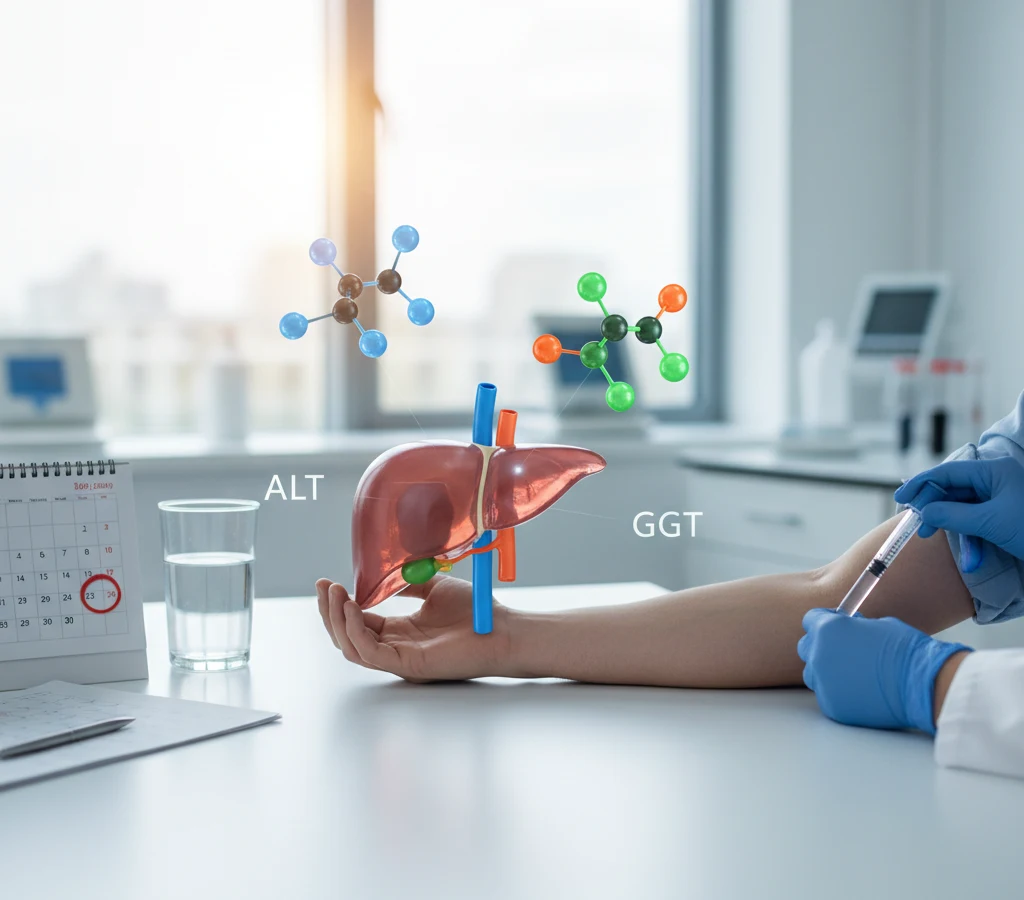
- ALT, or alanine aminotransferase: An enzyme found mainly in the liver. An elevation suggests liver-cell injury but does not identify its cause.
- AST, or aspartate aminotransferase: An enzyme found in the liver and other tissues, including muscle. Muscle injury can therefore raise AST without a primary liver problem.
- GGT, or gamma-glutamyl transferase: An enzyme that may increase through alcohol-related enzyme induction or liver and bile-duct problems. It is not specific enough to establish harmful drinking by itself.
The term “liver function test” can be misleading: ALT and AST primarily indicate injury, not how well the liver performs all its functions. Bilirubin, albumin and clotting measurements provide different information and must also be interpreted in context. A healthcare provider uses these tools to help diagnose potential issues.
Can occasional drinking cause high ALT or AST?
Short answer: Occasional drinking does not reliably predict ALT or AST results. An abnormal result should not automatically be attributed to a recent drink.
- Evidence: ALT and AST elevations have multiple possible causes. Evidence from chronic heavy-drinking populations does not establish how an isolated drinking episode will affect these markers.
- Exceptions: Existing health conditions affecting the liver, metabolic risk factors and medicines affect interpretation. Substantial alcohol exposure may also occur without high ALT or AST.
- Sample type: Usually venous blood for ALT and AST.
- Relevant test: Clinician-selected ALT and AST measurements. Product reference: Liver Function Test.
- Medical source: MedlinePlus: ALT Blood Test and the ACG alcohol-associated liver health condition guideline.
“Occasional” describes frequency, not dose. A person drinking once a month might have one drink or several drinks in a short period; these are different exposures. A large wine glass or strong mixed drink may also contain more alcohol than expected.
If ALT or AST is elevated after a social occasion, several explanations remain possible: alcohol contributed, another health condition caused the elevation, or more than one factor is involved. Metabolic dysfunction-associated steatotic liver health conditions, previously commonly called nonalcoholic fatty liver, are one important alternative.
Neither a normal result nor a single abnormal result can tell you whether a particular drinking pattern is safe for you. Avoid using liver enzymes as a personal “alcohol tolerance” test.
How long do liver enzymes stay elevated after drinking alcohol?
Short answer: If alcohol has raised liver enzymes, improvement may take days to weeks, while persistent injury can keep results abnormal for longer. There is no dependable countdown from the last drink to a normal result.
- Evidence: Small studies on the removal of metabolic byproducts show that some markers can improve within the first days of abstinence. A separate observational study found improvements in liver markers after one month without alcohol.
- Exceptions: These findings do not predict recovery after a single drinking episode. Advanced liver health conditions, continued drinking, other liver health factors and medication effects can alter the timeline.
- Sample type: Repeat blood testing, usually venous blood, using comparable methods where possible.
- Relevant test: Clinician-selected repeat liver blood tests. Product reference: Liver Function Test.
- Medical source: Trajectory of liver function tests during the initial alcohol withdrawal period and BMJ Open: Short-term abstinence from alcohol.
Different markers need not move together. AST and ALT may begin to fall once ongoing cell injury decreases. GGT often changes more slowly and may remain elevated for several weeks. Bilirubin or other measurements may follow a different pattern.
Alcohol leaving the bloodstream is not the same as the liver recovering. A person can have no measurable blood alcohol while liver enzymes remain elevated. Likewise, feeling sober or no longer having a hangover does not establish that blood markers have returned to baseline.
Published timelines are population averages. The one-month abstinence study involved selected participants and was not a rule-setting trial for laboratory preparation. It does not mean that everyone needs to wait a month for testing.
Most importantly, normalization does not prove that all liver injury or scarring has resolved. When appropriate, clinicians may assess fibrosis using additional blood-based calculations, imaging or elastography rather than relying on enzyme levels alone.
How long should you stop drinking before a liver blood test?
Short answer: Follow the instructions for your specific test; there is no universal 24-hour, 48-hour or one-week abstinence rule. For tests assessing a response to stopping alcohol, your clinician should decide the alcohol-free interval and repeat-testing schedule.
- Evidence: Laboratory preparation depends on the tests ordered and their clinical purpose. Liver-related guidance emphasizes drinking history and clinical assessment rather than a single standard waiting period.
- Exceptions: Urgent investigations should not be delayed. People at risk of alcohol withdrawal should not abruptly stop without medical advice.
- Sample type: Usually venous blood. Where a service expressly supports home sample collection, follow its documented preparation and collection instructions.
- Relevant test: The blood tests ordered by your clinician. Product reference: Liver Function Test.
- Medical source: MedlinePlus: Liver Function Tests and NHS: Alcohol misuse—treatment and withdrawal safety.
Separate two different goals:
- Preparing for a scheduled blood draw: The laboratory may give instructions about fasting, alcohol, medicines or collection time. Follow those instructions exactly rather than substituting a general internet recommendation.
- Assessing change after reducing or stopping alcohol: This is a clinical follow-up plan. Depending on the initial results and symptoms, reassessment may happen within days, after several weeks or alongside other investigations.
Avoid treating 24–48 hours without alcohol as a “reset.” It may satisfy a particular laboratory’s preparation instructions, but it does not measure if all alcohol-related enzyme changes have disappeared.
If you drank the night before, contact the ordering clinician or laboratory. Tell them roughly how much you drank and when. They may still want the sample, particularly when the purpose is to screen for symptoms or understand your current liver health.
Be candid about your usual pattern as well as your last drink. Brief abstinence solely to obtain a lower result can make the clinical picture harder to interpret if that context is not shared.
Can ALT, AST or GGT results show whether alcohol has damaged your liver?
Short answer: These results can provide clues, but they cannot provide a diagnosis of alcohol-related liver health conditions or measure its severity on their own. Normal enzymes do not rule out significant liver health conditions.
- Evidence: A doctor's diagnosis draws on drinking history, examination, blood tests and, when appropriate, imaging or other assessments. AST exceeding ALT may support an alcohol-related explanation in the right setting, but the pattern is not diagnostic.
- Exceptions: Other forms of advanced liver health conditions and muscle injury can produce misleading patterns. GGT can rise with medicines and non-alcohol-related health conditions.
- Sample type: Venous blood for laboratory assessment; ultrasound and elastography do not require a blood sample.
- Relevant test: Clinician-selected liver blood tests, with additional assessment where indicated. Product reference: Liver Function Test.
- Medical source: NIDDK: Diagnosis of Liver Scarring and MedlinePlus: GGT Test.
An AST-to-ALT ratio above two is sometimes described as a clue to alcohol-associated liver injury. However, not everyone with alcohol-related health conditions has this ratio, and the ratio alone cannot identify the cause. It is especially unhelpful to interpret a ratio without considering the actual enzyme values.
The laboratory’s reference range, previous results, symptoms and other measurements matter. A result just outside the reference range and a value many times above it require different assessments, but neither should be interpreted solely through drinking history.
Clinicians may review bilirubin, albumin, platelet count and clotting results, as well as kidney function. Not every commercially named liver panel includes all these measurements, so check the actual marker list rather than assuming that the panel is comprehensive.
What should you do if your liver test is abnormal after drinking?
Short answer: Arrange a clinical review rather than assuming alcohol is the only cause or waiting indefinitely for the result to normalize. The next step depends on the degree of elevation, symptoms and other results.
- Evidence: Abnormal liver enzymes have multiple possible causes, including metabolic liver health conditions, viral issues, medicines, autoimmune factors and bile-duct disorders.
- Exceptions: Marked abnormalities or concerning symptoms may need prompt investigation rather than a routine repeat test after abstinence.
- Sample type: Usually venous blood; additional investigations may include imaging.
- Relevant test: Clinician-selected hepatitis testing where indicated. Product reference: Hepatitis Test – Hepatitis B & C (analyzed in a CLIA-certified, CAP-accredited laboratory; HSA/FSA eligible — check with your plan administrator).
- Medical source: MedlinePlus: Liver Function Tests and MedlinePlus: AST Test.
Share your usual alcohol intake, recent heavy-drinking episodes, prescriptions, over-the-counter medicines, food supplements and recent strenuous exercise. Do not stop prescribed medicines without advice.
Your clinician may repeat the panel to confirm an unexpected finding, investigate likely causes immediately or do both. A falling result after stopping alcohol can be useful information, but it does not exclude another health condition.
A laboratory test using a sample collected at home may provide a starting point for discussion with a healthcare provider if that collection method and use are supported by the service’s documented intended purpose and instructions. Such testing cannot establish that alcohol is responsible, exclude every liver health condition or determine whether you need imaging. Avoid repeatedly self-testing without a plan for reviewing abnormal findings with a doctor.
When should you seek urgent care instead of waiting for another liver test?
Short answer: Seek urgent medical assessment for new jaundice, severe abdominal pain, persistent vomiting or rapidly worsening health status. Vomiting blood, black tarry stools, confusion, seizures or severe withdrawal symptoms require emergency care.
- Evidence: Liver health conditions can cause serious complications, while alcohol withdrawal can progress to seizures or delirium. Neither situation can be safely assessed through routine laboratory testing alone.
- Exceptions: Mild enzyme elevations without symptoms are often reviewed in an outpatient setting, but the clinician must determine urgency from the actual results.
- Sample type: Urgent clinical assessment may include venous blood and other investigations; do not wait to arrange sample collection yourself.
- Medical source: NIDDK: Symptoms and Causes of Liver Scarring and NHS: Alcohol withdrawal guidance.
If reducing alcohol causes shaking, sweating, nausea, feelings of nervousness or a racing heartbeat, seek medical advice promptly. Previous withdrawal seizures, hallucinations or severe withdrawal are particularly important warning signs. Do not try to force an alcohol-free interval for testing without an appropriate safety plan.
Bottom line: A liver test after drinking is not automatically invalid. Honest context, test-specific preparation and appropriate follow-up are more useful than choosing an arbitrary waiting period.
This article is for general information and is not a substitute for professional medical advice. Talk to a healthcare provider about your results.